Calories in eggnog: store-bought, homemade and spiked, per cup and per glass
A cup of store-bought eggnog is 340 to 366 calories, not the 224 most apps show. Carton labels, homemade by recipe, light versions and what rum or bourbon adds.
By Sheeraz Ali · Published November 22, 2026 · 7 min read
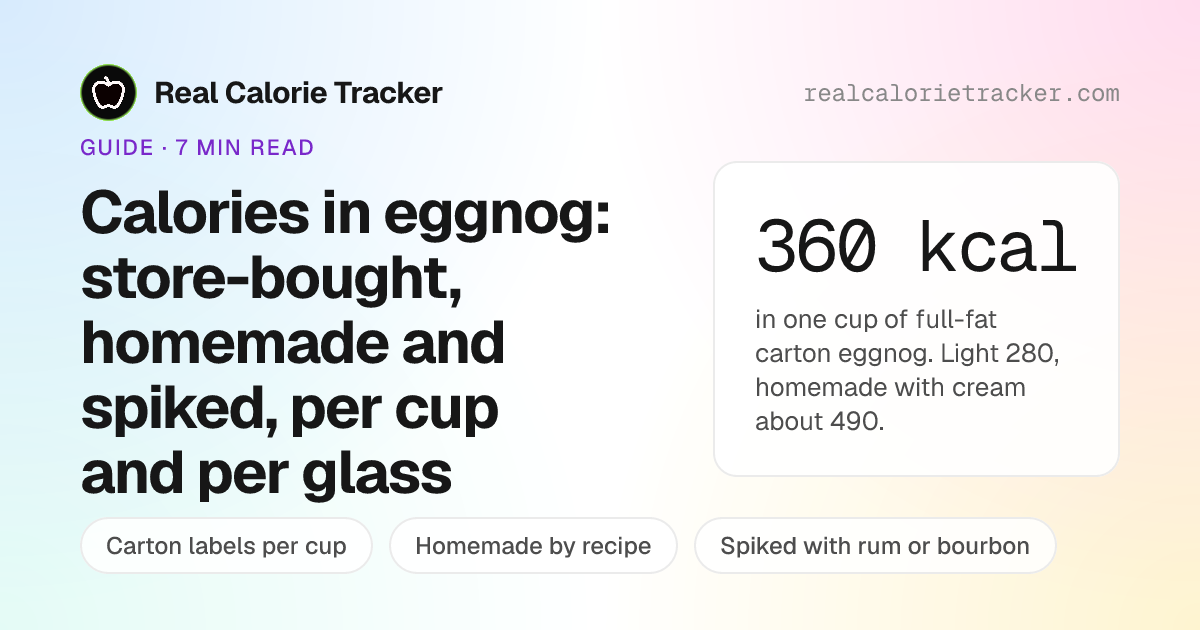
A cup of full-fat eggnog from a carton is 340 to 366 calories. Every big US dairy label I checked lists 170 or 180 calories per half-cup serving, and nobody pours a half cup. A light eggnog is 280 a cup. Homemade with cream and egg yolks is about 490, and a shot of rum or bourbon adds 97 to 105 on top.
If your calorie app says 224, it is using USDA’s old SR Legacy eggnog record (FDC 171258, 88 calories per 100 g), which our eggnog page shows too. That number is fine for the product it measured. It just doesn’t describe what’s in the dairy aisle now, and the reason is in the fat column, below.
Store-bought eggnog, per serving and per cup
| Eggnog | Label serving | Calories | Per cup (240 ml) | Fat per cup | Added sugar per cup |
|---|---|---|---|---|---|
| Hood Golden Eggnog | ½ cup (120 ml) | 180 | 360 | 18 g | 32 g |
| Kemps Golden Egg Nog | ½ cup (118 ml) | 180 | 366 | 18 g | 26 g |
| Garelick Farms Eggnog | ½ cup (120 ml) | 170 | 340 | 18 g | 24 g |
| Hood Light Eggnog | ½ cup (120 ml) | 140 | 280 | 8 g | 34 g |
| USDA SR Legacy eggnog | 1 cup (254 g) | 224 | 224 | 10.6 g | not listed |
| INDB egg nog (Indian home recipe) | 1 tall glass (305 g) | 296 | about 246 | 13 g | not listed |
The labels agree with each other to within 10 calories a serving. USDA is the outlier, 116 to 142 calories a cup below them.
Light eggnog is the odd one out in a different way. Hood’s light version cuts the fat from 9 g to 4 g a serving but keeps the same 22 g of carbohydrate and has slightly more added sugar (17 g against 16), so it saves 40 calories per half cup and none of the sugar.
Why the USDA number is too low
Eggnog is one of the few drinks with a federal recipe. The US standard of identity, 21 CFR 131.170, says anything sold as “eggnog” must contain at least 6 percent milkfat, 8.25 percent milk solids and 1 percent egg yolk solids by weight.
The USDA SR Legacy record has 4.2 g of fat per 100 g. That’s 4.2 percent, below the legal minimum, so whatever was sampled wasn’t a product that could carry the name today. The carton labels work out at about 7 percent (9 g of fat in roughly 125 g of eggnog), which is exactly where you’d expect a dairy to sit when it has to clear 6 with some margin.
Fat is 9 calories a gram, so the gap compounds quickly. A cup of Hood Golden has 18 g of fat (162 calories) and 42 g of sugars (168), and those two together are 330 of its 360.
“Eggnog-flavored” drinks, “holiday nog” and plant-based nogs aren’t bound by that standard. Some are much lighter than the real thing and some aren’t. Read the carton, and double the half-cup number.
Homemade eggnog, by recipe
Homemade is where eggnog gets heavy, because a typical recipe uses heavy cream as a third of the liquid. These are my builds from USDA ingredient records (egg yolk 322 per 100 g, whole milk, heavy cream, sugar), uncooked weight, with a cup at USDA’s 254 g. Cooked-custard versions lose a little water and come out a few percent higher per cup.
| Recipe (makes 3½ to 4 cups) | Whole batch | Per cup | Fat per cup | Added sugar per cup |
|---|---|---|---|---|
| Rich: 6 yolks, 2 cups milk, 1 cup cream, ¾ cup sugar | 2,021 | 524 | 34 g | 39 g |
| Classic: 4 yolks, 2 cups milk, 1 cup cream, ½ cup sugar | 1,718 | 488 | 34 g | 28 g |
| No cream: 4 yolks, 3 cups whole milk, ½ cup sugar | 1,058 | 298 | 12 g | 28 g |
| Light: 3 whole eggs, 3 cups 2% milk, ⅓ cup sugar | 845 | 226 | 8 g | 18 g |
The cream is the whole story. One cup of heavy cream is 809 calories, nearly half of the classic batch, and swapping it for a cup of whole milk takes the per-cup number from 488 to 298. The yolks matter less than people think: four of them are 219 calories across the batch, about 60 a cup. Sugar sits in between at 110 a cup for the classic recipe.
If you only change one thing, drop the cream. The no-cream version still tastes like eggnog, especially with nutmeg grated fresh on top, and it’s 190 calories a cup lighter. If you want it thicker, use one extra yolk rather than cream. That costs about 15 calories a cup.
Spiked eggnog
| Add to a cup of eggnog | Amount | Calories added |
|---|---|---|
| Rum, brandy or vodka, 80 proof (FDC 174815) | 1.5 fl oz shot (42 g) | 97 |
| Bourbon or whiskey, 86 proof | 1.5 fl oz shot (42 g) | 105 |
| Two shots of rum | 3 fl oz (84 g) | 194 |
| Coffee cream liqueur, Irish cream style (FDC 175098) | 1.5 fl oz (47 g) | 154 |
USDA’s survey database has a ready-mixed alcoholic eggnog record (FDC 2710684) at 113 calories per 100 g, built from 195 g of USDA eggnog and a 42 g shot, or 271 for the 240 g drink. Made with a real carton instead, the same drink is about 370: roughly 275 for the eggnog and 97 for the rum. The alcohol calories are the smaller part. Spirits are about 7 calories a gram of alcohol, and the alcohol guide has the per-drink math for everything else you might be pouring.
Fitting eggnog into a December
Eggnog is a dessert you drink. A cup of carton eggnog is about two 50 g slices of plum cake (187 each), and it doesn’t fill you up the way the cake does.
- Pour the label serving and mean it. Half a cup in a small glass is 170 to 180. A mug filled to the top is 300 ml or more, and that’s 450.
- Cut it half and half with milk. Half a cup of Hood Golden and half a cup of skim milk is 221 calories a cup and still tastes clearly of eggnog, because the nutmeg and vanilla carry. With whole milk it’s 254.
- Make the no-cream recipe at home. 298 a cup against 488.
- Count the shot separately. The rum isn’t hidden in the eggnog line of your log, so log it as its own drink. It’s easier to see two drinks than one.
- Pick one December treat a day. Two cups of eggnog with a plate of Christmas cookies is over 1,000 calories before dinner. If you want a hot drink instead, the hot chocolate guide shows a homemade mug at well under a cup of eggnog.
Log the carton by its label in the tracker, with the cup as the serving, and if December is a maintenance month for you, the TDEE calculator tells you how much room a daily cup takes up.
This guide is general nutrition information, not medical advice. Homemade eggnog made with raw eggs carries a food safety risk; use pasteurised eggs or cook the custard. If you’re pregnant or don’t drink alcohol for medical reasons, skip the spiked versions.
This guide is general information, not medical advice. If you're pregnant, have a medical condition or take medication, talk to a doctor or registered dietitian before changing how you eat.
Written by Sheeraz Ali
Sheeraz builds Real Calorie Tracker and uses it every day. The guides come from his own food tracking and from the IFCT 2017, INDB and USDA data behind the site, with sources linked in the text.
Put it into practice
Log your first meal by grams or by serving. Free, no account needed.
More guides
- What 1,200 calories looks like: two real days, and who should not eat it
Two full 1,200-calorie days, Western (131 g protein) and Indian veg (68 g), item by item. Plus the maths on who 1,200 suits and why most men should skip it.
- What 1,500 calories looks like in a day: three real menus
Three full days at 1,500 calories, Western, Indian vegetarian and Indian non-veg, meal by meal with calories and protein for every item. Plus how to tell whether 1,500 is the right number for you.
- What 1,800 calories looks like: three real days, and who it is a diet for
Three full 1,800-calorie days, home-cooked (137 g protein), a bought-lunch workday and Indian veg, item by item. Plus who 1,800 makes lose weight and who it makes gain.