How long does it take to lose 10 kg? Week counts by deficit, and why the second 5 kg is slower
About 26 weeks on a 500-calorie daily deficit, 16 on 750 and 12 on 1,000. Modelled week by week as your maintenance falls, plus who can safely go faster.
By Sheeraz Ali · Published November 14, 2026 · 7 min read
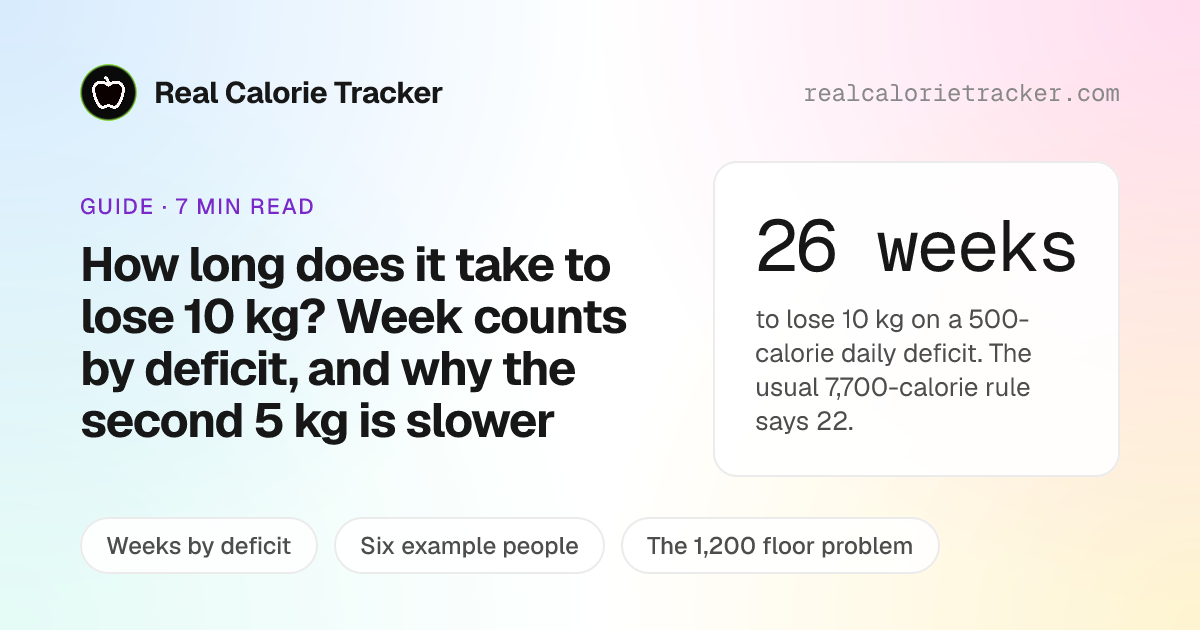
Losing 10 kg takes about 26 weeks (six months) on a 500-calorie daily deficit, about 16 weeks on 750, and about 12 weeks on 1,000. Those are the honest numbers for fat loss, once you allow for the fact that a lighter body burns less. The quick sum most pages give (10 kg × 7,700 calories ÷ 500 a day = 22 weeks) is four weeks too optimistic, and the gap gets bigger the smaller your deficit.
The NHS suggests aiming for 0.5 to 1 kg a week, which on paper means 10 to 20 weeks. Most people land at the slow end of that or past it, for reasons this page puts numbers on.
Weeks to lose 10 kg, by daily deficit
I ran this the way our calorie deficit calculator works: Mifflin–St Jeor for maintenance, about 7,700 calories per kilogram of fat, and a fixed daily intake set at the start. Then, unlike the calculator, I recalculated maintenance every day as the weight came off. The example is a 35-year-old man, 175 cm, 90 kg, lightly active, but the week counts barely change with the person; a sedentary 80 kg woman at 160 cm lands within a week of every figure from 500 up (and at 60 weeks rather than 64 on the 250 row).
| Daily deficit at the start | The 7,700 rule says | With maintenance falling | First 5 kg | Second 5 kg |
|---|---|---|---|---|
| 250 kcal | 44 weeks | 64 weeks | 26 weeks | 38 weeks |
| 500 kcal | 22 weeks | 26 weeks | 12 weeks | 14 weeks |
| 750 kcal | 15 weeks | 16 weeks | 8 weeks | 9 weeks |
| 1,000 kcal | 11 weeks | 12 weeks | 6 weeks | 6 weeks |
For 20 pounds (9.1 kg), the same model gives 23 weeks at 500 a day and 15 weeks at 750.
The second 5 kg is slower because the deficit shrinks under you. Every kilo you lose takes 10 calories off your resting burn in the Mifflin equation, and your activity multiplier scales that up to about 14 calories a day for a lightly active person. Ten kilos is 138 calories a day. On a 1,000-calorie deficit that barely registers. On a 250-calorie deficit it eats more than half the gap, which is why a “small, easy” deficit on the same food for a year takes far longer than people expect.
This model is the optimistic version. It assumes you eat exactly the target every day and that only the equation’s weight term changes. Kevin Hall’s modelling in The Lancet (2011) found the body’s response to a change in intake is slow, with a half-time of about a year, and Thomas and colleagues (2013) compared the old 3,500-calorie-per-pound rule against seven tightly controlled feeding studies and found it overpredicted weight loss. Treat every number in the table as the fastest you will see, not the average.
Who can actually run each deficit
The bigger limit is not physiology but arithmetic. Your deficit can only be as large as the gap between your maintenance and a sensible minimum intake. Our calculator floors targets at 1,200 calories for women and 1,500 for men, and flags any rate above 1 percent of body weight a week. Here is what that means for six people, all aged 35:
| Person | Maintenance | Fastest sensible target | Weeks to lose 10 kg at that target | Weeks at a 500 deficit |
|---|---|---|---|---|
| Woman, 155 cm, 68 kg, desk job | 1,575 | 1,200 (375 deficit) | 35 | 25, but only by eating 1,075 |
| Woman, 160 cm, 75 kg, lightly active | 1,944 | 1,200 (744 deficit) | 16 | 26 |
| Woman, 165 cm, 90 kg, lightly active | 2,193 | 1,203 (990 deficit) | 12 | 26 |
| Man, 170 cm, 80 kg, desk job | 2,031 | 1,500 (531 deficit) | 24 | 25 |
| Man, 175 cm, 90 kg, lightly active | 2,508 | 1,518 (990 deficit) | 12 | 26 |
| Man, 180 cm, 110 kg, exercises 3 to 5 days | 3,185 | 1,975 (1,210 deficit) | 10 | 26 |
The first row is the one nobody writes about. A small, sedentary woman starting at 68 kg has a maintenance of 1,575, so even at the 1,200 floor her deficit is only 375 a day. Ten kilograms takes her about eight months, and going faster means eating below 1,200, which is where hunger, protein and micronutrients all get hard to manage. The 1,200 calorie day shows how tight that budget is. Her real lever is the other side of the equation: 10,000 steps a day adds about 245 net calories at 70 kg (the steps guide has it by weight), which would cut her timeline from about 35 weeks to about 20.
The last row is the opposite. A heavy, active man can run a 1,200-calorie deficit and still eat nearly 2,000 a day. Ten kilograms in ten weeks is realistic for him, and it is about 1 percent of his body weight a week, the top of what the calculator calls safe.
What the first month looks like on the scale
Fast, then disappointing. The first one to two weeks of any diet show more loss than the table, because cutting food also cuts the carbohydrate stored as glycogen, and each gram of glycogen is held with three to four grams of water (Kreitzman et al., 1992). Less food in the gut weighs less too. People see 2 kg in week one, assume the rate will continue, and then week three shows 0.3 kg and they decide the diet has stopped working.
It has not. Week three is the real rate. On a 500-calorie deficit, real fat loss is about 0.45 kg a week, and normal day-to-day water swings are bigger than that. Weigh every morning and judge only the weekly average. If three weekly averages in a row are flat, the calorie deficit not working guide walks through the eight usual causes, starting with the 300 to 500 calories most logs miss.
Where a 500-calorie deficit comes from
Half a kilo a week sounds like a lot of food. It is usually two or three things you would not miss, from our food database:
| Cut or add | Calories a day |
|---|---|
| Walk 10,000 steps at 70 kg (net, normal pace) | 245 |
| Skip one samosa (60 g) | 185 |
| Two cups of chai with 2 tsp sugar each, skipped | 172 (Indian drinks guide) |
| Two chocolate chip cookies (32 g) | 156 |
| One can of cola (355 ml) | 149 |
| One small bag of potato chips (28 g) | 150 |
| One tablespoon less oil in the day’s cooking | 124 |
| A whole-milk grande latte swapped for black coffee | 267 |
Any two of the bottom six plus the walk is 500. That is how I would build it: one change to what you drink, one to what you cook with, and steps. Cutting meals instead tends to cost protein, and protein is what protects muscle while the weight comes off. The macros for weight loss guide sets it at 1.8 g per kg.
Faster than 12 weeks
Losing 10 kg in a month, which plenty of search results promise, needs a deficit of about 2,500 calories a day for most people. That is more than many women burn in total. What those plans actually deliver is the water from the first fortnight plus a few kilos of fat, followed by the water coming back when normal eating resumes. A crash diet is also where muscle loss stops being a footnote.
If you have a deadline, the useful question is not “how fast can I go” but “how big a deficit can I hold every day until then”. Most people hold 500 to 750 without much drama. Plan the date from that, then recalculate your target in the calorie deficit calculator every 5 kg, since the second 5 kg starts with a maintenance about 70 calories lower than the first. The tracker keeps the weekly averages for you.
This guide is general information, not medical advice. If you have a medical condition, take medication that affects weight, are pregnant or breastfeeding, or have a history of disordered eating, talk to a doctor or registered dietitian before setting a deficit.
This guide is general information, not medical advice. If you're pregnant, have a medical condition or take medication, talk to a doctor or registered dietitian before changing how you eat.
Written by Sheeraz Ali
Sheeraz builds Real Calorie Tracker and uses it every day. The guides come from his own food tracking and from the IFCT 2017, INDB and USDA data behind the site, with sources linked in the text.
Put it into practice
Log your first meal by grams or by serving. Free, no account needed.
More guides
- What 1,200 calories looks like: two real days, and who should not eat it
Two full 1,200-calorie days, Western (131 g protein) and Indian veg (68 g), item by item. Plus the maths on who 1,200 suits and why most men should skip it.
- What 1,500 calories looks like in a day: three real menus
Three full days at 1,500 calories, Western, Indian vegetarian and Indian non-veg, meal by meal with calories and protein for every item. Plus how to tell whether 1,500 is the right number for you.
- What 1,800 calories looks like: three real days, and who it is a diet for
Three full 1,800-calorie days, home-cooked (137 g protein), a bought-lunch workday and Indian veg, item by item. Plus who 1,800 makes lose weight and who it makes gain.