Calories burned walking 10,000 steps: about 245 extra for a 70 kg person, not 400
10,000 steps at a normal pace burns about 370 calories gross for a 70 kg (154 lb) person, but only 245 more than sitting. Tables by weight and pace inside.
By Sheeraz Ali · Published November 5, 2026 · 8 min read
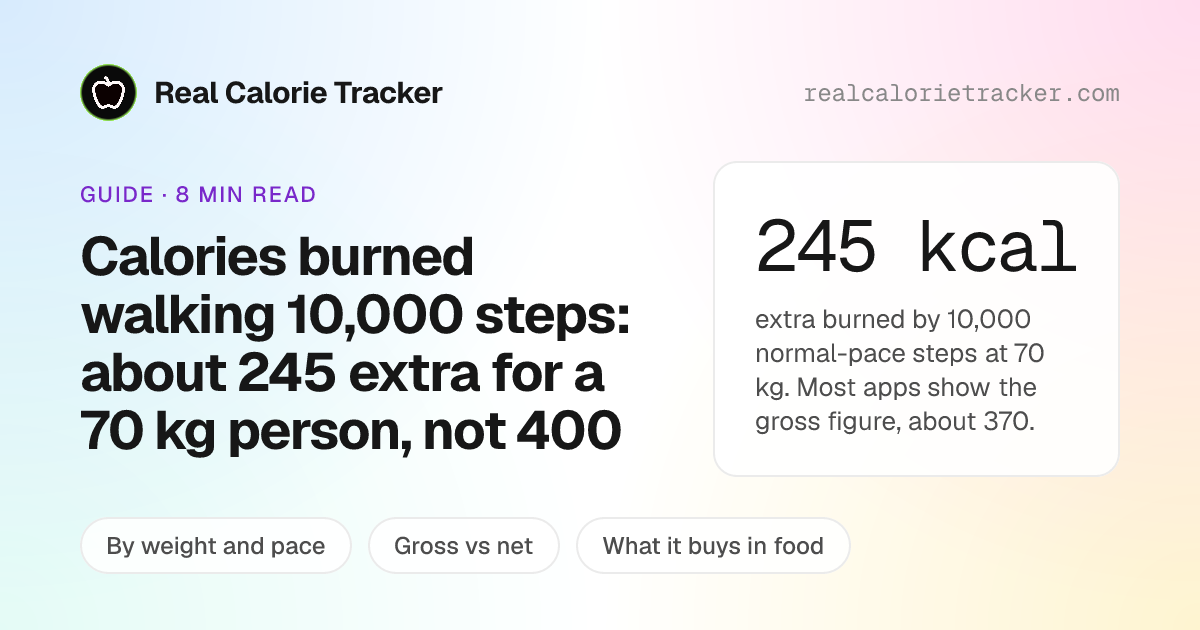
For a 70 kg (154 lb) person walking at a normal pace, 10,000 steps burns about 370 calories in total, and about 245 more than you would have burned sitting on the sofa for the same 100 minutes. That second number is the one that matters if you are trying to lose weight, because it is the only part of the burn that the walk actually added. Walk briskly and the extra rises to about 410. Weigh 100 kg and it is 350 at a normal pace.
Most pages that rank for this give “300 to 500 calories” and leave it there. That range is not wrong, but it mixes two different numbers. Below is how the figure is built, a table by body weight and pace, and what 245 calories looks like on a plate.
The numbers, by body weight and pace
Each cell shows gross / net calories for 10,000 steps. Gross is everything you burn during the walk. Net is gross minus what your body would have burned at rest over the same time, which is the extra the walk earns you.
| Body weight | Normal pace (100 steps/min, about 100 minutes) | Brisk pace (120 steps/min, about 83 minutes) |
|---|---|---|
| 55 kg (121 lb) | 289 / 193 | 401 / 321 |
| 70 kg (154 lb) | 368 / 245 | 510 / 408 |
| 85 kg (187 lb) | 446 / 298 | 620 / 496 |
| 100 kg (220 lb) | 525 / 350 | 729 / 583 |
How I got there. A MET (metabolic equivalent) is a multiple of resting energy use, and 1 MET is about 1 kcal per kg per hour. The CADENCE-Adults study measured 76 adults on a treadmill with a calorimeter and found that 100 steps a minute marks 3 METs (moderate intensity) and 130 steps a minute marks 6 METs. That matches the 2024 Adult Compendium of Physical Activities, which lists walking at 2.5 mph on a firm, level surface at 3.0 METs and a brisk 3.5 to 3.9 mph at 4.8. For the brisk column I used 5 METs at 120 steps a minute, interpolated between the two CADENCE thresholds, so treat it as a good estimate rather than a measurement.
Then it is arithmetic. 10,000 steps at 100 a minute is 100 minutes. 3 METs for 100 minutes at 70 kg is about 368 calories. One of those three METs is your resting metabolism, which was going to happen anyway, so the walk itself added two METs’ worth: 245.
A second method gets the same answer. The ACSM walking equation, the standard one in exercise physiology, puts the oxygen cost of level walking at 0.1 ml per kg per metre on top of resting. That works out to roughly 0.5 calories per kg per kilometre, and it holds across normal walking speeds (about 3 to 6 km/h). At step lengths of 65 to 75 cm, which covers most adults, 10,000 normal steps is 6.5 to 7.5 km, so a 70 kg walker spends 230 to 260 net calories. Two independent routes, same number.
Why your watch says more
Three things inflate the figure you see on a phone or wrist.
It is showing gross, not net. Most trackers add “active calories” on top of a resting estimate, which is fine, but step-based calorie counters and online “10,000 steps calculators” usually quote the gross figure. If you then add that to a daily target that already includes your resting burn, you count the same 100 minutes of metabolism twice. For a 70 kg person that is about 120 calories a day of food you did not earn.
Wrist devices are poor at energy expenditure. In the Stanford study of seven wrist-worn devices, no device got calorie burn within 20 percent, and error was highest for walking of all the activities tested. Heart rate was accurate. Calories were not. Newer watches are better but still read high, more so for people with more body fat (how accurate fitness trackers are for calories burned). The calorie deficit guide covers what this does to people who eat back their exercise.
Not all steps are walking steps. 10,000 steps logged across a day includes shuffling to the kitchen, pacing on calls and the walk from the car park. Those steps come slowly and in bursts of a few seconds, well under the 100-a-minute pace that counts as even moderate intensity. A day of 10,000 scattered steps costs less than one 100-minute walk, and a step counter cannot tell the two apart. The table above assumes deliberate walking.
What 245 calories looks like
The point of knowing the net number is to see what a walk does and does not pay for. A 70 kg person’s 10,000 normal-pace steps, against things people eat on the same day:
| Food | Portion | Calories | Share of the walk’s 245 net kcal |
|---|---|---|---|
| Banana | 1 medium (118 g) | 105 | 43% |
| Chocolate chip cookies | 2 (32 g) | 156 | 64% |
| Samosa | 1 (60 g) | 185 | 76% |
| Beer | 1 pint (473 ml) | 203 | 83% |
| Croissant | 1 medium (57 g) | 231 | 94% |
| Latte, whole milk | 1 grande (480 ml) | 269 | 110% |
| Glazed donut | 1 (60 g) | 271 | 111% |
| Cheese pizza | 1 slice (107 g) | 285 | 116% |
| French fries | 1 medium (117 g) | 365 | 149% |
A hundred minutes of walking is cancelled by one grande latte. That is not an argument against walking. It is an argument against treating the walk as permission. The people who lose weight with steps are the ones who walk and do not eat more because of it.
Over a week the numbers get more respectable. 245 net calories a day is about 1,700 a week, which on paper is a little over 0.2 kg of fat. Done every day for three months without eating more, that is real. The other half is logging accurately enough that a 245-calorie gap shows up at all, which is what how to count calories accurately is about.
How to count steps in your calorie target
Pick one of these and stick to it. Mixing them is how the double-counting happens.
Option 1: put the steps in your activity level. The TDEE calculator multiplies your resting burn by an activity factor. Sedentary (1.2) assumes very little walking. If you reliably walk 10,000 steps a day, choosing “lightly active” (1.375) instead adds 0.175 × your resting burn: about 280 calories for a person whose resting burn is 1,600. That is close to the net figure in the table, which is a nice check that the multipliers are sane. Then do not add anything back from your watch.
Option 2: set sedentary and add net calories on walking days. Use the net column above, not the tracker’s number. A 70 kg person who walks 10,000 brisk steps adds about 400 that day, and nothing on days they do not walk.
Option 1 is easier and works better for most people because it smooths out the days. Option 2 suits people whose walking is lumpy: big walks on weekends, little on weekdays. Either way the calorie deficit calculator will turn the result into a daily target.
Pace matters more than people think
Look at the table again. At 70 kg, going from 100 to 120 steps a minute raises the net burn from 245 to 408 calories for the same 10,000 steps, and it takes 17 fewer minutes. Brisk walking costs disproportionately more per minute than strolling, and you also cover more ground with each step because your stride lengthens. If you only have time for one walk, walk it faster. Per mile the picture is different: speed barely changes the cost of a fixed distance, which calories burned walking a mile shows by pace and body weight.
Hills do the same. The Compendium puts walking up a 6 to 10 percent grade at 7 METs, more than double level walking at a normal pace. A route with a long climb can add 30 to 50 percent to the burn without adding a single step. Body weight matters in the obvious direction: a 100 kg walker burns 80 percent more than a 55 kg walker on the same route, because they are carrying 80 percent more mass.
Steps are worth it for reasons calories miss
The 245-calorie figure is the honest answer to the calorie question, and it is smaller than people hope. The health case for walking is stronger. A 2022 meta-analysis of 15 cohorts in The Lancet Public Health, covering 47,471 adults, found that mortality risk kept falling with more daily steps up to about 6,000 to 8,000 steps a day for adults 60 and over, and 8,000 to 10,000 for younger adults. The group averaging 10,901 steps had about half the risk of the group averaging 3,553. None of that depends on how many calories the steps burned.
So the practical version: walk 8,000 to 10,000 steps because it is good for you, put it into your activity level once, and get the deficit from what you eat. Stairs follow the same logic at a steeper rate: 8 calories a minute but under 2 a floor, as calories burned climbing stairs works out by body weight. If you want to see where the food side stands, log a normal day in the tracker. For most people, cutting one 250-calorie habit is easier than adding another 10,000 steps, and the highest-protein foods per calorie are a good place to find the swaps.
This guide is general information, not medical advice. If you have a heart, joint or other medical condition, or are pregnant, check with your doctor before starting a new walking routine, and talk to a doctor or registered dietitian before changing how much you eat.
This guide is general information, not medical advice. If you're pregnant, have a medical condition or take medication, talk to a doctor or registered dietitian before changing how you eat.
Written by Sheeraz Ali
Sheeraz builds Real Calorie Tracker and uses it every day. The guides come from his own food tracking and from the IFCT 2017, INDB and USDA data behind the site, with sources linked in the text.
Put it into practice
Log your first meal by grams or by serving. Free, no account needed.
More guides
- What 1,200 calories looks like: two real days, and who should not eat it
Two full 1,200-calorie days, Western (131 g protein) and Indian veg (68 g), item by item. Plus the maths on who 1,200 suits and why most men should skip it.
- What 1,500 calories looks like in a day: three real menus
Three full days at 1,500 calories, Western, Indian vegetarian and Indian non-veg, meal by meal with calories and protein for every item. Plus how to tell whether 1,500 is the right number for you.
- What 1,800 calories looks like: three real days, and who it is a diet for
Three full 1,800-calorie days, home-cooked (137 g protein), a bought-lunch workday and Indian veg, item by item. Plus who 1,800 makes lose weight and who it makes gain.