Calories in guava: one amrud by size, white vs pink, and why tables say 32 or 68
A 150 g Indian guava is about 50 calories (white) to 70 (pink) by IFCT 2017; US tables say 102. Per fruit by size, fibre, vitamin C, and which number to log.
By Sheeraz Ali · Published November 18, 2026 · 7 min read
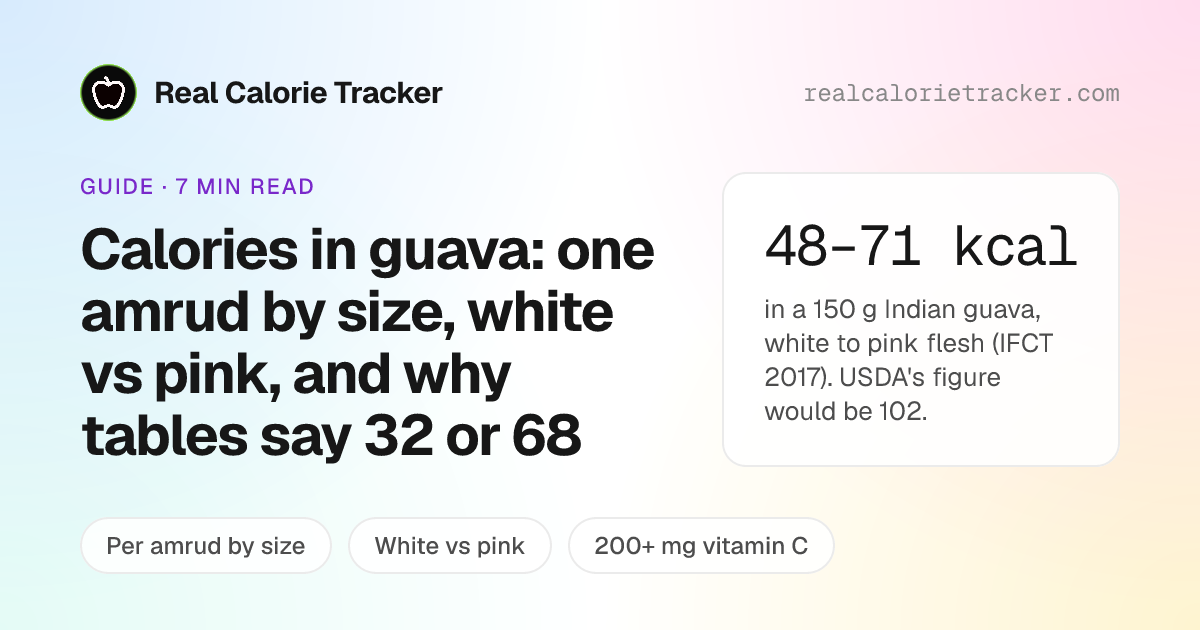
A typical Indian guava of about 150 g is 48 calories if it’s a white-fleshed amrud and 71 if it’s pink, using IFCT 2017, India’s national food composition table. The same fruit run through USDA’s numbers comes out at 102. That is a 2x spread for one fruit, and it’s the reason guava calorie pages online disagree so badly.
My answer: log a ripe guava at about 50 calories per 100 g, between IFCT’s white and pink values, and you’ll be close whatever the variety. The rest of this guide shows where the three numbers come from. The guava rows are in the Indian food database alongside 1,400 other Indian foods.
Calories in one guava, by size
| Guava | Weight | White flesh (IFCT) | Pink flesh (IFCT) | USDA common guava | Fibre (IFCT white) |
|---|---|---|---|---|---|
| USDA’s “1 fruit” | 55 g | 18 | 26 | 37 | 4.7 g |
| Small | 100 g | 32 | 47 | 68 | 8.6 g |
| Medium | 150 g | 48 | 71 | 102 | 12.9 g |
| Large | 200 g | 64 | 94 | 136 | 17.2 g |
| 1 cup, chopped | 165 g | 53 | 78 | 112 | 14.2 g |
USDA’s 55 g “fruit” is a small guava, about the size of an egg. Indian commercial guavas are much bigger. A 2023 review of guava cultivar trials in India (Singh et al., Plant Archives) collects studies where average fruit weight ran from about 118 g to 221 g depending on cultivar, with Sardar (Lucknow-49) at 171 g in one comparison. So the 150 g row is a normal amrud from a thela, and the 200 g row is the big one you cut into four. If you log “1 guava” from an app built on US data, you’re logging 55 g, a third of what you ate.
The fruit is almost all edible. The seeds, skin and flesh all go down, so whole weight minus the stalk is the number to use.
Why the tables say 32, 47 and 68
Three things separate USDA’s 68 calories per 100 g from IFCT’s 32 for white guava, and they’re worth knowing because the same gaps show up across fruit.
How fibre is counted: about 17 calories of the gap. Guava is extremely high in fibre, 5.4 g per 100 g in USDA’s sample and 8.6 g in IFCT’s. USDA works out carbohydrate “by difference” (whatever isn’t water, protein, fat or ash) and multiplies all of it, fibre included, by 3.6 calories per gram. IFCT 2017 measured available carbohydrate directly and gave the fibre very little energy, under half a calorie per gram on our reading of its figures. Your gut gets something in between. Gut bacteria ferment fibre into fatty acids you absorb, and the FAO’s 2003 report on food energy recommends counting it at 2 calories per gram. On that basis, the 8.6 g of fibre in 100 g of white guava is worth about 17 calories, of which IFCT’s figure counts about 3.
Sugar: about 11 calories. USDA’s guava had 8.9 g of sugar per 100 g; IFCT’s white guava had 4.1 g and the pink 7.8 g. That’s not a lab disagreement. Guava sugar varies a lot with variety and ripeness, and the same review lists Indian trials measuring total sugars anywhere from about 3.4 to 9.6 percent. Sugar rises as the fruit ripens, so a hard, crunchy guava eaten with salt and chilli sits near the bottom of that range and a soft, fragrant one near the top.
Protein and fat: about 8 calories. USDA’s sample had 2.6 g protein and 1 g fat per 100 g, against 1.4 g and 0.3 g in IFCT’s white guava.
Put back the fibre energy that IFCT leaves out, at FAO’s 2 calories per gram, and white guava comes to about 47 calories per 100 g and pink to about 59. That’s why I use 50. It’s also why you shouldn’t treat the USDA 68 as wrong: it describes a sweeter, richer sample, counted generously.
Guava against the other winter fruits
Guava season in north India runs through winter, which is also when oranges, chikoo, amla and papaya are cheapest. All values are IFCT 2017 per 100 g, so they compare directly with each other.
| Fruit (IFCT 2017) | Calories | Sugar | Fibre | Vitamin C |
|---|---|---|---|---|
| Amla (Indian gooseberry) | 24 | 3.4 g | 7.8 g | 252 mg |
| Papaya, ripe | 24 | 4.1 g | 2.8 g | 43 mg |
| Mosambi | 27 | 3.4 g | 2.1 g | 47 mg |
| Guava, white flesh | 32 | 4.1 g | 8.6 g | 214 mg |
| Orange (santra) | 37 | 6.9 g | 1.3 g | 43 mg |
| Guava, pink flesh | 47 | 7.8 g | 7.4 g | 222 mg |
| Pomegranate | 55 | 10.9 g | 2.8 g | 13 mg |
| Apple, big | 62 | 9.5 g | 2.6 g | 4 mg |
| Chikoo (sapota) | 73 | 12.3 g | 9.6 g | 21 mg |
| Custard apple (sitaphal) | 99 | 13.4 g | 5.1 g | 22 mg |
| Banana, robusta | 105 | 13.7 g | 1.9 g | 5 mg |
Guava is the best fruit on this list for anyone counting calories, and it’s not close. Per 100 g, white guava has six times the fibre of a santra, nearly 60 times the vitamin C of an apple, and under a third of a banana’s calories. Only amla beats it on vitamin C, and nobody eats amla by the 150 g fruit. Even the fruit with the vitamin C reputation loses: on USDA values guava has 336 mg per 100 calories against 152 for a green kiwi.
One medium guava carries 321 to 333 mg of vitamin C by IFCT, four times ICMR-NIN’s 2020 requirement of 80 mg a day for men and 65 mg for women. An orange gets you to roughly the daily amount; a guava gets you there with plenty spare.
Chikoo is the trap. It looks like a modest brown fruit and is more than twice the calories of white guava, with three times the sugar: 73 calories per 100 g, about 70 percent of a banana. It does have the most fibre of any fresh fruit in IFCT, so it isn’t a bad fruit; it just isn’t a free one.
Guava in other forms
| Food | Portion | Calories | Fibre |
|---|---|---|---|
| Guava, medium, with salt and chilli | 150 g | 48–71 | 11–13 g |
| Guava jelly (INDB) | 1 tbsp (20 g) | 23 | 1.3 g |
| Guava jelly (INDB) | 100 g | 116 | 6.6 g |
| Strawberry guava (USDA), a different small species | 100 g | 69 | 5.4 g |
Salt and chilli add nothing worth counting. Guava jelly is a jam: 116 calories per 100 g, nearly four times the white fruit, and it goes on toast in the same tablespoons as any other jam. Bottled guava drinks are not in our database; most sold in India are nectars, meaning water, sugar and some pulp, so read the label and log it from there.
Guava for weight loss
A 150 g guava for 50 to 70 calories, with 11 to 13 g of fibre, is about as much food as you can get for that budget. It takes several minutes to eat, the seeds and skin slow you down, and the fibre fills you. In high-fibre Indian foods, guava is the best fruit by a distance, and swapping 100 g of banana for 100 g of guava saves 58 to 73 calories while adding 5 to 7 g of fibre.
Two practical notes. Ripe, soft guavas are sweeter, and my estimate is closer to 60 per 100 g; hard green ones closer to 45. And a lot of fibre at once from guava seeds disagrees with some stomachs; if one makes you bloated, eat half and see.
Log guava by weight in the tracker, or use the lowest-calorie Indian foods list for more fruit and vegetables under 50 calories per 100 g.
This guide is general nutrition information. If you manage diabetes or a digestive condition, ask your doctor or dietitian how fruit fits your plan.
This guide is general information, not medical advice. If you're pregnant, have a medical condition or take medication, talk to a doctor or registered dietitian before changing how you eat.
Written by Sheeraz Ali
Sheeraz builds Real Calorie Tracker and uses it every day. The guides come from his own food tracking and from the IFCT 2017, INDB and USDA data behind the site, with sources linked in the text.
Put it into practice
Log your first meal by grams or by serving. Free, no account needed.
More guides
- What 1,200 calories looks like: two real days, and who should not eat it
Two full 1,200-calorie days, Western (131 g protein) and Indian veg (68 g), item by item. Plus the maths on who 1,200 suits and why most men should skip it.
- What 1,500 calories looks like in a day: three real menus
Three full days at 1,500 calories, Western, Indian vegetarian and Indian non-veg, meal by meal with calories and protein for every item. Plus how to tell whether 1,500 is the right number for you.
- What 1,800 calories looks like: three real days, and who it is a diet for
Three full 1,800-calorie days, home-cooked (137 g protein), a bought-lunch workday and Indian veg, item by item. Plus who 1,800 makes lose weight and who it makes gain.