Calories in chikoo (sapota): per fruit by size, in a shake, and against other fruit
One medium chikoo is about 50 calories (68 g of pulp, IFCT 2017), not the 141 that US apps log. Per fruit by size, chikoo shake estimates, and fruit per 100 kcal.
By Sheeraz Ali · Published November 19, 2026 · 7 min read
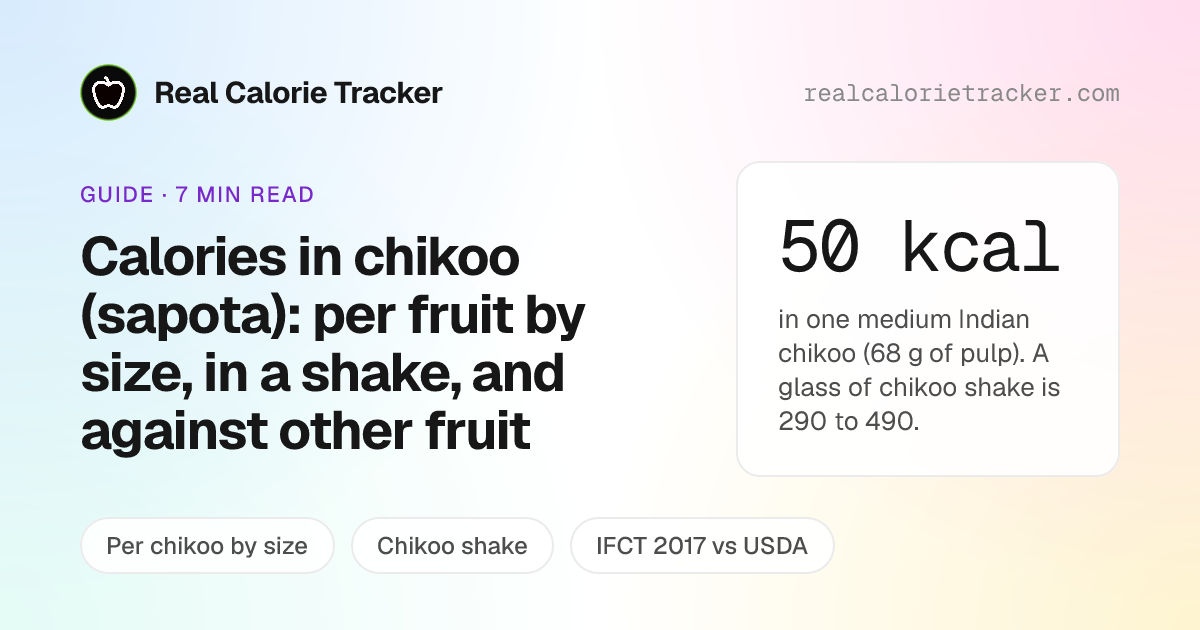
One medium Indian chikoo gives you about 68 g of pulp, and that is 50 calories by IFCT 2017, India’s national food composition table. A small one is about 33 and a big one 72. If you log “1 sapodilla” in an app built on US data, it will say 141, because USDA’s fruit weighs 170 g, more than twice a typical Kalipatti from an Indian market.
So the calorie confusion with chikoo is mostly about size, not about the fruit. Per 100 g of pulp, the two tables are only 10 calories apart: IFCT says 73 and USDA says 83. Both rows are in our food database: sapota (IFCT) and sapodilla (USDA), next to 1,400 other foods in the Indian food hub.
Calories in one chikoo, by size
Chikoo has a thin brown skin and two to five shiny black seeds, and you eat neither. Weights below are edible pulp, which is what the tables measure.
| Chikoo | Whole fruit | Pulp you eat | IFCT sapota | USDA sapodilla | Fibre (IFCT) |
|---|---|---|---|---|---|
| Small | about 60 g | 45 g | 33 | 37 | 4.3 g |
| Medium | about 90 g | 68 g | 50 | 56 | 6.5 g |
| Large | about 130 g | 98 g | 72 | 81 | 9.4 g |
| USDA’s “1 sapodilla” | 170 g | 124 | 141 | 16.3 g | |
| 1 cup of pulp | 241 g | 176 | 200 | 23.1 g |
The size rows come from Indian field trials. In a 2016–17 trial of Kalipatti, the most popular table variety, at Punjab Agricultural University (Kaur and Bons, Indian Journal of Agricultural Sciences, 2019), untreated fruit averaged 66 g whole with 47 g of pulp, and the largest treated fruit averaged 88 g with 71 g of pulp. So 71 to 80 percent of a chikoo is the part you eat, and the rest is skin and seeds. I use 75 percent: weigh the whole fruit, multiply by 0.75, then by 0.73 for calories.
USDA’s 170 g fruit is a big sapodilla of the kind sold in the Americas. Larger round varieties such as Cricket Ball come closer to it, but a typical Kalipatti from a fruit cart is in the 60 to 100 g range, and it takes two to three of them to make one USDA sapodilla.
Why chikoo is sweeter than it looks
Chikoo pulp is 12.3 g of sugar per 100 g by IFCT, and the Punjab trial measured 9.8 to 14.4 percent total sugars depending on treatment. That’s more than an apple (9.5 g in IFCT’s big apple) and less than a ripe banana. Almost all of chikoo’s calories are that sugar plus a little starch. It has 0.9 g of protein and 1.3 g of fat per 100 g, neither of which matters.
The grainy, pear-like texture is the other half of the story. Chikoo has 9.6 g of fibre per 100 g in IFCT, the most of any fresh fruit in the table. That fibre is why IFCT and USDA disagree less here than they do for guava. USDA counts carbohydrate “by difference,” fibre included, and gives it full energy; IFCT measured available carbohydrate and gives fibre almost nothing. With guava, where sugar also differs, that adds up to a 2x gap (the guava guide has the breakdown). With chikoo, available carbohydrate is close in both tables (13.9 g in IFCT, about 14.7 in USDA) and the gap is only 10 calories.
Ripeness changes the taste more than the count. Chikoos are picked hard and ripened off the tree (the Punjab fruit spent four days wrapped in newspaper), and as they soften, starch turns to sugar. That is why a soft, brown-fleshed one tastes so much sweeter than a firm one. The calories barely move, since starch and sugar are both carbohydrate.
Chikoo against other fruit, per 100 calories
The useful comparison for anyone counting is how much fruit 100 calories buys. All IFCT 2017 except pomegranate.
| Fruit | Grams for 100 kcal | What that looks like |
|---|---|---|
| Papaya, ripe | 417 g | A third of a medium papaya |
| Guava, white flesh | 312 g | Two medium amrud |
| Orange (santra) | 270 g | Three or four santras |
| Mango, kesar | 182 g | Most of one kesar |
| Apple, big | 161 g | One apple |
| Chikoo (sapota) | 137 g | Two medium chikoos |
| Fig, fresh | 122 g | Three figs |
| Pomegranate (USDA) | 120 g | One cup of arils |
| Grapes, black seedless | 112 g | About 20 to 25 grapes |
| Custard apple (sitaphal) | 101 g | The pulp of one sitaphal |
| Banana, robusta | 95 g | One medium banana |
| Dates, dry | 32 g | Three or four khajur |
Chikoo sits in the middle. Two medium chikoos and one medium banana cost the same, but the chikoos have about 13 g of fibre against 2 g. That makes chikoo a better fruit than its “too sweet” reputation, as long as you count it. It is not a free fruit like papaya or guava, where you can eat a plateful for 100 calories.
If you have one chikoo after lunch, it’s 50 calories and not worth worrying about. The calories show up when a dozen sit in a bowl on the counter and you pass it all day. Four a day is 200 calories, more than a katori of plain dal.
Chikoo shake: where the calories actually are
Chikoo is mostly eaten as a milkshake, and most of a shake’s calories come from what goes in with the fruit. There is no chikoo shake row in INDB or IFCT, so these are estimates built from ingredients: 150 g of chikoo pulp (two medium-to-large fruit), 200 ml of milk and 2 tsp of sugar.
| Chikoo shake (estimate) | Calories | Protein |
|---|---|---|
| With cow’s milk (IFCT, 4.5% fat) | 286 | 8 g |
| With buffalo or full-cream milk (6.6% fat) | 354 | 9 g |
| Cow’s milk plus 1 scoop vanilla ice cream | 423 | 10 g |
| Full-cream milk plus 1 scoop ice cream, juice-bar style | 491 | 11 g |
| Chikoo alone, 150 g | 110 | 1 g |
A juice-bar chikoo shake is more than two rotis and a katori of dal (about 410), and it doesn’t keep you full for long. In DiMeglio and Mattes’ 2000 trial, people given 450 extra calories a day as a drink ate no less food to make up for it, while the same calories as solid food were mostly compensated for. The fruit is the smallest line in that table. The milk and the scoop of ice cream do the damage, and skipping the 2 tsp of sugar only saves 31: ripe chikoo is sweet enough without it.
If you want the shake, make it at home with toned milk and no sugar, and log it as two chikoos plus a glass of milk. The Indian drinks guide has milk by type per glass, so you can swap in whatever’s in your fridge.
Chikoo and blood sugar
There is very little research on chikoo’s glycaemic index. The one measured value I could find is from a Brazilian study of nine tropical fruits (Passos et al., Food Science and Technology, 2015), which put sapodilla at a GI of 37 ± 27.9, with a glycaemic load of 4 for a 70 g portion. That’s in the low range, but each fruit was tested on only six people, and a spread of ±28 means the true figure could reasonably be anywhere from low to moderate. Treat it as a hint, not a number.
The practical answer for anyone watching blood sugar is the one that applies to every sweet fruit: one chikoo (about 8 g of sugar) eaten whole with a meal is a very different thing from a 490-calorie shake on an empty stomach. If you have diabetes, your doctor or dietitian can tell you how fruit fits your plan.
Log chikoo by the fruit or by weight in the tracker; the low-calorie Indian foods list has the fruit that cost less, and the high-fibre Indian foods guide shows where chikoo’s 9.6 g of fibre ranks.
This guide is general nutrition information. If you manage diabetes or a digestive condition, ask your doctor or dietitian how fruit fits your plan.
This guide is general information, not medical advice. If you're pregnant, have a medical condition or take medication, talk to a doctor or registered dietitian before changing how you eat.
Written by Sheeraz Ali
Sheeraz builds Real Calorie Tracker and uses it every day. The guides come from his own food tracking and from the IFCT 2017, INDB and USDA data behind the site, with sources linked in the text.
Put it into practice
Log your first meal by grams or by serving. Free, no account needed.
More guides
- What 1,200 calories looks like: two real days, and who should not eat it
Two full 1,200-calorie days, Western (131 g protein) and Indian veg (68 g), item by item. Plus the maths on who 1,200 suits and why most men should skip it.
- What 1,500 calories looks like in a day: three real menus
Three full days at 1,500 calories, Western, Indian vegetarian and Indian non-veg, meal by meal with calories and protein for every item. Plus how to tell whether 1,500 is the right number for you.
- What 1,800 calories looks like: three real days, and who it is a diet for
Three full 1,800-calorie days, home-cooked (137 g protein), a bought-lunch workday and Indian veg, item by item. Plus who 1,800 makes lose weight and who it makes gain.