High-fibre Indian foods, ranked per serving: whole dals, millets, guava and methi
Kala chana has 25 g of fibre per 100 g raw, toor dal 9, white rice 3. The Indian staples ranked by fibre per serving, and the swaps that add 10 g a day.
By Sheeraz Ali · Published November 3, 2026 · 8 min read
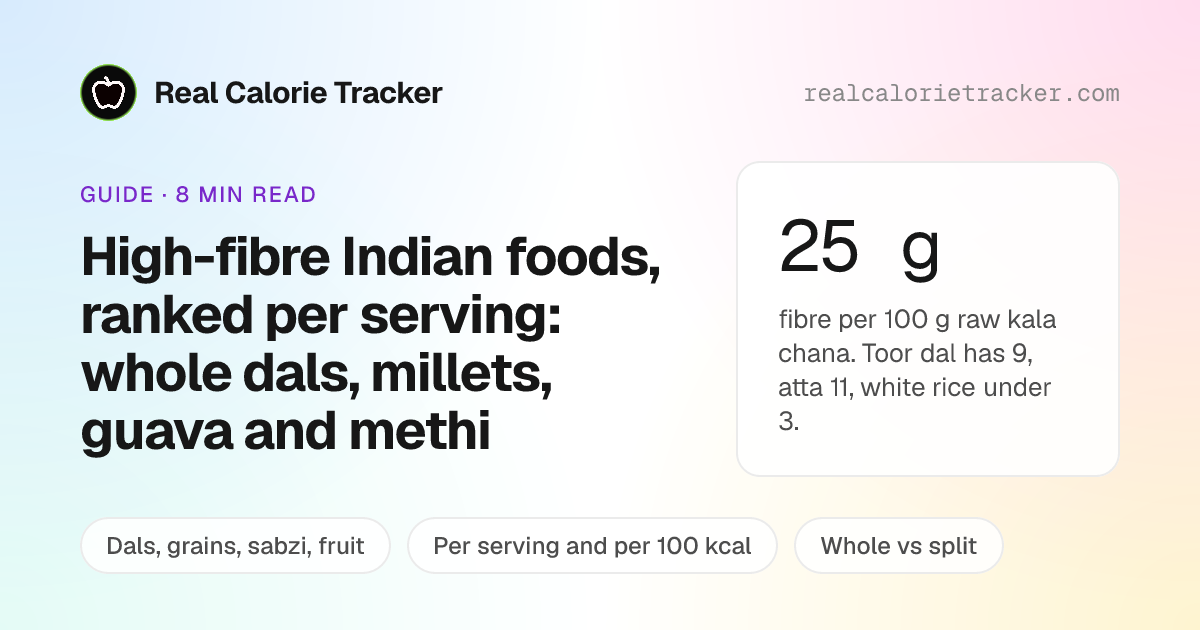
The highest-fibre Indian staple is whole kala chana, at 25 g of fibre per 100 g raw, followed by whole toor, whole urad and whole moong at 17 to 23 g. The best fibre for the fewest calories comes from vegetables like drumstick, methi, bhindi and brinjal, and from guava, which IFCT puts at 8.6 g per 100 g for only 32 calories. At the bottom are white rice, maida, poha and idli, which carry 1 to 2 g per serving.
The single most useful finding in the data is that whole dals have 1.6 to 2.5 times the fibre of the same dal split and dehusked. Switching from yellow moong dal to whole green moong changes nothing about the calories and nearly doubles the fibre.
Raw values below are from IFCT 2017, the Indian Food Composition Tables from ICMR-NIN; cooked dishes are INDB recipes and our curated entries in the Indian food database. Every food links to its page.
Dals and pulses: whole beats split, every time
Per 30 g raw, which is roughly one person’s katori of dal:
| Pulse (raw) | Fibre per 30 g | Calories | Protein | Fibre per 100 kcal |
|---|---|---|---|---|
| Kala chana, whole Bengal gram | 7.6 g | 86 | 5.6 g | 8.8 g |
| Whole toor (red gram) | 6.8 g | 82 | 6.2 g | 8.3 g |
| Soya bean | 6.8 g | 113 | 11.3 g | 6.0 g |
| Whole urad (black gram) | 6.1 g | 87 | 6.6 g | 7.0 g |
| Whole moong (green gram) | 5.1 g | 88 | 6.8 g | 5.8 g |
| Whole masoor | 5.0 g | 90 | 6.8 g | 5.6 g |
| Rajma, red | 5.0 g | 90 | 6.0 g | 5.6 g |
| Chana dal | 4.6 g | 99 | 6.5 g | 4.6 g |
| Urad dal, split | 3.6 g | 97 | 6.9 g | 3.7 g |
| Masoor dal, split | 3.1 g | 97 | 7.3 g | 3.2 g |
| Moong dal, split | 2.8 g | 98 | 7.2 g | 2.9 g |
| Toor dal, split | 2.7 g | 99 | 6.5 g | 2.7 g |
| Horse gram (kulthi) | 2.4 g | 99 | 6.5 g | 2.4 g |
Toor is the starkest case: whole toor has 6.8 g per 30 g, split toor dal 2.7 g. That gap is the seed coat. Fibre in a pulse sits mostly in the husk, and dehusking strips it off. Notice too that the whole pulses come out 7 to 17 calories lighter per 30 g, because fibre displaces some of the starch and contributes little usable energy.
Horse gram, sold all over the internet as a high-fibre weight-loss food, is at the bottom of this table in IFCT’s analysis. It is a good pulse, but on fibre it loses to every whole dal and to chana dal.
The split dals are still decent. A thick katori of everyday dal is 6 g of fibre. INDB’s thin washed moong dal is 1.8 g per katori, because there is very little lentil in each spoonful. Fibre follows the dry weight in the pot, not the volume in the bowl; the calories in dal guide shows the same effect for calories.
Grains: atta and millets far ahead of rice
Per the amount of raw grain or flour in one typical portion:
| Grain (raw) | Portion | Fibre | Calories | Fibre per 100 kcal |
|---|---|---|---|---|
| Maize (makki) | 40 g, one makki roti | 4.9 g | 134 | 3.7 g |
| Bajra | 40 g, one bhakri | 4.6 g | 139 | 3.3 g |
| Ragi | 40 g, one roti or a bowl of malt | 4.5 g | 128 | 3.5 g |
| Jowar | 40 g, one bhakri | 4.1 g | 134 | 3.1 g |
| Rava / semolina | 40 g, one bowl of upma | 3.9 g | 134 | 2.9 g |
| Atta (whole wheat) | 30 g, one roti | 3.4 g | 96 | 3.6 g |
| Brown rice | 58 g, one cup cooked | 2.6 g | 205 | 1.2 g |
| White rice | 58 g, one cup cooked | 1.6 g | 206 | 0.8 g |
| Maida (refined flour) | 30 g | 0.8 g | 106 | 0.8 g |
The portion weights for millet rotis are my estimate of a standard bhakri; ours are not in the database as cooked breads yet. Makki ki roti is usually cooked with ghee, which takes it to 224 calories; the sarson ka saag guide has the full winter plate. The order is the point: one atta roti has about twice the fibre of a full cup of white rice, for a little over half the calories. Maida has a quarter of atta’s fibre, which is why naan, bhatura, white bread and most bakery biscuits contribute almost nothing.
Millets look ahead of atta here only because a bhakri uses more flour than a roti. Per calorie, ragi, bajra and atta are within a few tenths of a gram. If you prefer jowar or bajra bhakri, good, but do not switch from roti expecting a big fibre jump. The jump is from rice or maida to any whole grain. Rice vs roti compares the two at equal calories.
Vegetables and fruit: the best fibre per calorie
The same pattern holds for Western foods, where berries, green beans and broccoli top the list; the high-fiber foods per calorie ranking covers 45 of them with USDA values.
Per 100 g raw, roughly one serving of sabzi or one medium fruit:
| Food (raw) | Fibre per 100 g | Calories | Fibre per 100 kcal |
|---|---|---|---|
| Broad beans (sem) | 8.6 g | 29 | 29.7 g |
| Guava, white flesh | 8.6 g | 32 | 26.9 g |
| Drumstick (moringa pods) | 6.8 g | 29 | 23.4 g |
| Brinjal | 4.0 g | 25 | 16.0 g |
| Bhindi (ladies finger) | 4.1 g | 27 | 15.2 g |
| Methi leaves | 4.9 g | 34 | 14.4 g |
| Chikoo (sapota) | 9.6 g | 73 | 13.2 g |
| Carrot | 4.2 g | 33 | 12.7 g |
| Cluster beans (gavar) | 4.8 g | 40 | 12.0 g |
| Apple | 2.6 g | 62 | 4.2 g |
| Banana (robusta) | 1.9 g | 105 | 1.8 g |
| Potato | 1.7 g | 70 | 2.4 g |
Guava is the best fruit in India for fibre by a long way, and chikoo is the surprise: 9.6 g per 100 g, more than any other fresh fruit in IFCT, though at 73 calories it is not as cheap as guava. Banana, the default fruit in most Indian homes, has a fifth of guava’s fibre.
A caution on these numbers. IFCT measures total dietary fibre and comes out higher than USDA for several foods: our USDA-based guava row is 5.4 g per 100 g against IFCT’s 8.6. Use the order with confidence; treat the exact grams as the upper end. The same gap shows up in calories, 32 per 100 g for white guava in IFCT against 68 in USDA, and calories in guava explains where it comes from and what a real amrud weighs.
Cooked dishes, per serving
| Dish | Serving | Fibre | Calories |
|---|---|---|---|
| Pea curry | 1 bowl (275 g) | 12.1 g | 283 |
| Brinjal bharta | 1 bowl (325 g) | 10.7 g | 211 |
| Kala chana curry | 1 bowl (120 g) | 9.6 g | 169 |
| Rajma | 1 katori (150 g) | 9 g | 210 |
| Chana masala | 1 katori (150 g) | 9 g | 240 |
| Sambar | 1 bowl (255 g) | 8.9 g | 247 |
| Carrot and methi sabzi | 1 bowl (190 g) | 8.4 g | 118 |
| Whole moong with tadka | 1 bowl (225 g) | 6.8 g | 142 |
| Dal, thick | 1 katori (150 g) | 6 g | 174 |
| Roti × 2 | 80 g | 3.9 g | 238 |
| Poha | 1 bowl (200 g) | 2 g | 260 |
| Idli × 2 | 80 g | 1 g | 108 |
| White rice | 1 cup (158 g) | 0.6 g | 205 |
The best-value plate on that list is carrot-methi sabzi: 8.4 g of fibre for 118 calories. Rajma and chole are the best all-rounders because they bring 9 to 10 g of protein with the fibre; the rajma chawal guide has them per plate. South Indian breakfasts are light on fibre unless sambar comes with them, which is a good reason to never skip the sambar.
How much you need, and the swaps that get you there
The WHO recommends at least 25 g of naturally occurring fibre a day for adults; the UK target is 30 g. Those numbers are not arbitrary. A 2019 Lancet review of 185 cohort studies and 58 trials found 15 to 30 percent lower all-cause mortality and rates of heart disease, stroke, type 2 diabetes and colorectal cancer in the highest fibre eaters compared with the lowest, with most of the benefit reached at 25 to 29 g a day. More on the targets is in how much fibre per day.
A common day of poha, roti with yellow moong dal, a banana, curd, and rice with dal at dinner adds up to about 18 g by our data. These swaps each keep the meal recognisable:
| Instead of | Have | Fibre added | Calorie change |
|---|---|---|---|
| Poha, 1 bowl | 2 besan cheela and 1 guava (100 g) | +11 g | −87 |
| 1 banana | 100 g chikoo or guava | +5.5 to +6.5 g | −32 to −73 |
| Yellow moong dal, 1 katori | Whole moong, same katori | +3 g | +20 |
| 1½ cups white rice | 1 cup rice and 1 roti | +1.5 g | +16 |
| Dry aloo sabzi, 1 bowl | Carrot-methi sabzi, 1 bowl | +6.4 g | +10 |
| Nothing | 1 tbsp flaxseed (alsi) in curd or atta | +2.6 g | +44 |
The first two swaps alone take that day to about 35 g, and neither needs a new recipe. Raise fibre over a couple of weeks rather than overnight, and drink more water as you do; a sudden jump from 15 to 40 g is a reliable route to a bloated week.
Log a normal day in the tracker, which shows fibre next to calories and protein, and see which of your meals are carrying you. The low-calorie Indian dishes list is a good place to find more of the vegetable dishes near the top of these tables.
This guide is general nutrition information, not medical advice. If you have IBS, inflammatory bowel disease or another digestive condition, ask your doctor or dietitian how much fibre suits you.
This guide is general information, not medical advice. If you're pregnant, have a medical condition or take medication, talk to a doctor or registered dietitian before changing how you eat.
Written by Sheeraz Ali
Sheeraz builds Real Calorie Tracker and uses it every day. The guides come from his own food tracking and from the IFCT 2017, INDB and USDA data behind the site, with sources linked in the text.
Put it into practice
Log your first meal by grams or by serving. Free, no account needed.
More guides
- What 1,200 calories looks like: two real days, and who should not eat it
Two full 1,200-calorie days, Western (131 g protein) and Indian veg (68 g), item by item. Plus the maths on who 1,200 suits and why most men should skip it.
- What 1,500 calories looks like in a day: three real menus
Three full days at 1,500 calories, Western, Indian vegetarian and Indian non-veg, meal by meal with calories and protein for every item. Plus how to tell whether 1,500 is the right number for you.
- What 1,800 calories looks like: three real days, and who it is a diet for
Three full 1,800-calorie days, home-cooked (137 g protein), a bought-lunch workday and Indian veg, item by item. Plus who 1,800 makes lose weight and who it makes gain.