Calories in an orange: by size, navel to clementine, and whole fruit vs juice
A medium orange (131 g, 2⅝ in across) is 62 calories; small 45, large 86, a navel 69, a clementine 35. Sizes, varieties, Indian santra and mosambi, and juice.
By Sheeraz Ali · Published November 18, 2026 · 7 min read
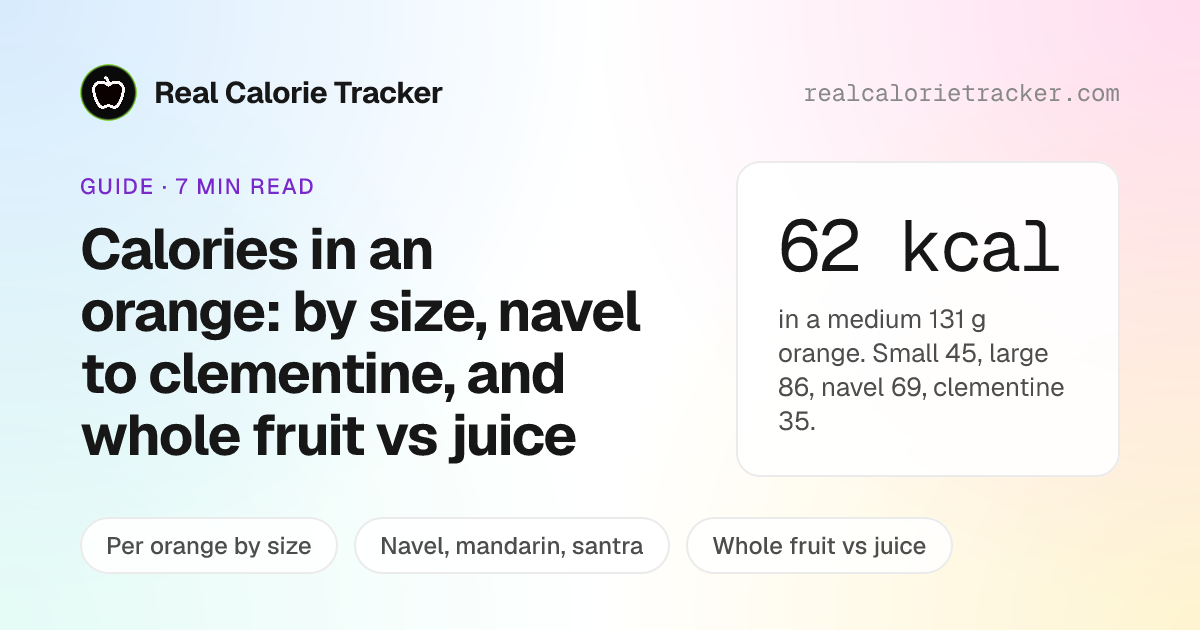
A medium orange, the 2⅝-inch fruit USDA weighs at 131 g, is 62 calories. A small one is 45 and a large one is 86. Almost all of it is carbohydrate: 15.5 g in a medium orange, of which about 12 g is sugar and 3.1 g is fibre, plus a gram of protein and next to no fat. It also carries about 70 mg of vitamin C, which is most of a day’s requirement.
Those numbers come from USDA’s standard raw orange record (FDC 169097), the same values our orange page uses: 47 calories per 100 g of fruit. If you have a scale, that one number is all you need. Weigh the segments after peeling, multiply by 0.47, and you’re done.
Calories in an orange, by size
| Orange | Weight | Calories | Carbs | Sugar | Fibre |
|---|---|---|---|---|---|
| Small (2⅜”) | 96 g | 45 | 11.3 g | 9.0 g | 2.3 g |
| Medium (2⅝”) | 131 g | 62 | 15.4 g | 12.2 g | 3.1 g |
| Large (3¹⁄₁₆”) | 184 g | 86 | 21.6 g | 17.2 g | 4.4 g |
| 1 cup sections | 180 g | 85 | 21.2 g | 16.8 g | 4.3 g |
| A big one, weighed peeled | 250 g | 118 | 29.4 g | 23.4 g | 6.0 g |
The USDA “medium” is a modest orange. A lot of the navels sold loose in winter are visibly bigger, and because weight rises with the cube of the diameter, an orange that looks a little larger is a lot heavier: going from 2⅝ to 3 inches across adds roughly half again. If the fruit fills your hand, log it as a large, or weigh it.
Navel, Valencia, mandarin, clementine
| Fruit | Per 100 g | One fruit | Sugar per 100 g | Fibre per 100 g | Vitamin C, one fruit |
|---|---|---|---|---|---|
| Navel orange | 49 | 69 (140 g) | 8.5 g | 2.2 g | 83 mg |
| Florida orange | 46 | 65 (141 g) | 9.1 g | 2.4 g | 63 mg |
| Valencia (FDC 169916) | 49 | 59 (121 g) | n/a | 2.5 g | 59 mg |
| Orange, all varieties | 47 | 62 (131 g) | 9.4 g | 2.4 g | 70 mg |
| Tangerine / mandarin, medium | 53 | 47 (88 g) | 10.6 g | 1.8 g | 23 mg |
| Tangerine / mandarin, large | 53 | 64 (120 g) | 10.6 g | 1.8 g | 32 mg |
| Clementine | 47 | 35 (74 g) | 9.2 g | 1.7 g | 36 mg |
Per 100 g, the varieties sit within 7 calories of each other. Mandarins are the densest at 53 because they carry less water (85 percent against nearly 87 for a standard orange) and more sugar in what’s left. They’re also the easiest to overeat, since you peel one in five seconds and the second one is already in your hand. Three clementines are 105 calories, the same as one large orange and a bit, and they don’t feel like a lot of fruit.
Navels are the vitamin C winners per fruit at 83 mg. Mandarins are oddly poor on it, 27 mg per 100 g against 53 for a standard orange, so a medium mandarin gives you a third of what an orange does. If you eat citrus partly for the vitamin C, buy oranges.
Indian santra and mosambi
IFCT 2017, India’s food composition table, gives lower numbers for the oranges sold in India.
| Fruit (IFCT 2017) | Per 100 g | At 131 g | Sugar per 100 g | Fibre per 100 g | Vitamin C per 100 g |
|---|---|---|---|---|---|
| Orange (santra), pulp | 37 | 48 | 6.9 g | 1.3 g | 43 mg |
| Sweet lime (mosambi), pulp | 27 | 35 | 3.4 g | 2.1 g | 47 mg |
The santra figure is 10 calories per 100 g below USDA’s orange, and here the gap is mostly the fruit rather than the arithmetic: IFCT’s samples had 89.6 percent water and 6.9 g of sugar against USDA’s 86.8 percent and 9.4 g. Botanically a Nagpur santra is a mandarin, which makes the gap bigger still: USDA’s mandarin is 53 per 100 g. Indian samples were simply wetter and less sweet. I log a santra at the IFCT value and a supermarket navel at USDA’s, and on a medium orange the difference is 13 calories. (The gap is not always real. For Indian apples and bananas, most of the difference comes from how the energy was calculated.)
Mosambi is the lightest citrus in either table: 27 calories per 100 g, with half the sugar of an orange. It tastes sweet because it’s low in acid, not because it’s high in sugar. A 131 g portion of mosambi segments is about 35 calories. A glass of mosambi juice from a stall is a different food: it takes several fruits to fill a glass, and stall juice is sometimes sweetened, so ask. The Indian drinks guide has per-glass numbers for the other stall drinks to compare against.
Whole orange vs orange juice
| Portion | Calories | Sugar | Fibre | |
|---|---|---|---|---|
| Orange, medium | 131 g | 62 | 12.2 g | 3.1 g |
| Orange juice, fresh | juice of 1 orange (86 g) | 39 | 7.2 g | 0.2 g |
| Orange juice, fresh | 150 ml (150 g) | 68 | 12.6 g | 0.3 g |
| Orange juice, fresh | 1 cup (248 g) | 112 | 20.8 g | 0.5 g |
| Orange juice, from concentrate | 1 cup (248 g) | 122 | n/a | 0.7 g |
| Orange, with peel (eaten whole) | 1 fruit (159 g) | 100 | n/a | 7.2 g |
USDA’s figure is that one orange yields 86 g of juice, so a cup of juice is the juice of about three oranges. It’s 112 calories with almost none of the fibre and none of the chewing, and it’s gone in 20 seconds. That is the whole case against juice. Per gram it isn’t worse than the fruit; you just drink far more fruit than you would ever eat.
The long-term data points the same way. In three large US cohorts of health professionals, Muraki et al. (BMJ, 2013) found that eating more whole fruit was linked to a slightly lower risk of type 2 diabetes, while each extra three glasses of fruit juice a week was linked to an 8 percent higher risk. It’s an observational study, so it can’t prove the juice did it, but the direction is the same as everything else we know. The NHS advice is to keep juice and smoothies to a combined 150 ml a day, which is 68 calories of orange juice and counts as one of your five a day no matter how much more you drink.
My rule: eat the orange, drink water. If you love juice with breakfast, pour 150 ml into a small glass rather than a tumbler and log it.
Vitamin C, per orange
India’s current recommended intake, set by ICMR-NIN in 2020, is 80 mg of vitamin C a day for men and 65 mg for women, up from 40 mg in the 2010 guidelines. A medium orange (70 mg) covers a woman’s day and most of a man’s. A navel covers either. Two clementines get you to 72 mg.
If vitamin C per calorie is what you’re after, oranges are not the best fruit. Guava has about four times the vitamin C per 100 g, and amla even more. A kiwi gets you 90 mg for 59 calories, against 80 for orange.
Oranges and weight loss
An orange is about 87 percent water and gives 5.1 g of fibre per 100 calories, which puts it near the top of high-fibre foods per calorie among fruits, ahead of an apple. It takes a minute to peel and segment, which slows you down in a way a banana doesn’t. Per calorie it’s one of the cheapest snacks you can carry, and the lowest-calorie fruits list has oranges at 47 per 100 g against 89 for a banana and 69 for grapes.
The only ways oranges cause trouble are the ones above: logging a 250 g navel as a 131 g “medium”, eating clementines by the bowl without counting, or drinking the juice. All three are easy to fix with a scale for a week, until you can judge an orange by eye.
Log oranges by size in the tracker, and browse every fruit by calories per 100 g in the fruits group.
This guide is general nutrition information. If you manage diabetes, ask your doctor or dietitian how fruit and juice fit your plan.
This guide is general information, not medical advice. If you're pregnant, have a medical condition or take medication, talk to a doctor or registered dietitian before changing how you eat.
Written by Sheeraz Ali
Sheeraz builds Real Calorie Tracker and uses it every day. The guides come from his own food tracking and from the IFCT 2017, INDB and USDA data behind the site, with sources linked in the text.
Put it into practice
Log your first meal by grams or by serving. Free, no account needed.
More guides
- What 1,200 calories looks like: two real days, and who should not eat it
Two full 1,200-calorie days, Western (131 g protein) and Indian veg (68 g), item by item. Plus the maths on who 1,200 suits and why most men should skip it.
- What 1,500 calories looks like in a day: three real menus
Three full days at 1,500 calories, Western, Indian vegetarian and Indian non-veg, meal by meal with calories and protein for every item. Plus how to tell whether 1,500 is the right number for you.
- What 1,800 calories looks like: three real days, and who it is a diet for
Three full 1,800-calorie days, home-cooked (137 g protein), a bought-lunch workday and Indian veg, item by item. Plus who 1,800 makes lose weight and who it makes gain.