Walking vs running for weight loss: running burns 1.5 times more per mile and 3 times more per half hour
At 150 lb, a mile burns 63 extra calories walking and 94 running; 30 minutes burns 95 against 282. Tables by weight and by week, plus appetite and injury data.
By Sheeraz Ali · Published November 9, 2026 · 8 min read
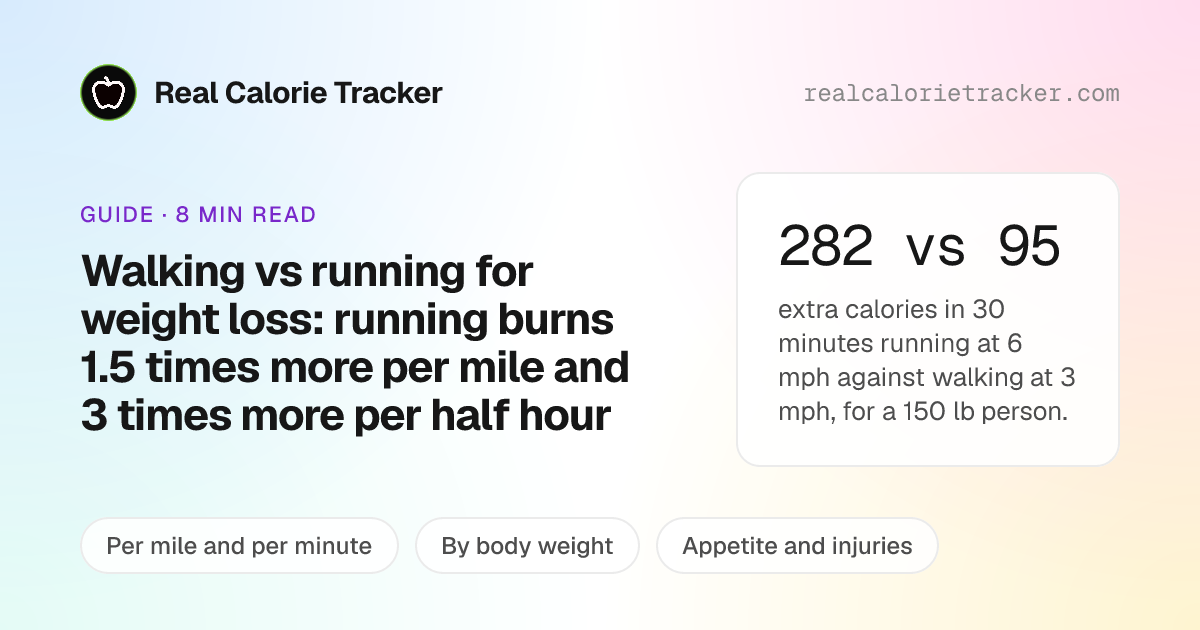
Running wins, but by less than you think per mile and by more than you think per minute. For a 150 lb (68 kg) person, a mile costs 63 extra calories walking at 3 mph and 94 running at 6 mph: about one and a half times as much. Half an hour is a different story: 95 extra calories walking, 282 running, three times as much, because the runner covers twice the distance in the same time and pays more for each mile of it.
So the answer depends on what you are short of. If time is the limit, run. If your knees, your fitness or your patience are the limit, walk further, because a walk you do every day beats a run you quit in March.
All the numbers here are net calories: what you burn above what you would have burned sitting on the sofa for the same minutes. That is the figure to weigh against food. Gross figures, which most calculators and watches show, include your resting burn and flatter slow activities. The method is the same as in calories burned walking a mile, which goes deeper on walking pace.
Per mile and per half hour, by body weight
Energy values come from the 2024 Adult Compendium of Physical Activities, which assigns each activity a MET value (multiples of resting burn). One MET is about 1 calorie per kg per hour, so net calories are (METs − 1) × kg × hours.
| Activity | Net per mile, 150 lb | Net per mile, 200 lb | Net in 30 min, 150 lb | Net in 30 min, 200 lb |
|---|---|---|---|---|
| Walk, 3 mph (20:00 per mile) | 63 | 85 | 95 | 127 |
| Brisk walk, 4 mph (15:00) | 77 | 102 | 153 | 205 |
| Easy jog, 5 mph (12:00) | 102 | 137 | 255 | 341 |
| Run, 6 mph (10:00) | 94 | 126 | 282 | 378 |
| Run, 7 mph (8:34) | 97 | 130 | 340 | 455 |
| Run, 8 mph (7:30) | 94 | 125 | 374 | 501 |
Two patterns jump out. First, once you are running, pace hardly changes the cost of a mile: 94 to 102 for a 150 lb person whether you jog at 5 mph or run at 8. The ACSM running equation, the standard one in exercise physiology, puts net running cost at 0.2 ml of oxygen per kg per metre whatever the speed, which works out to about 1 calorie per kg of body weight per kilometre. (The 5 mph row sits slightly high because the Compendium’s values come from different studies; treat it as noise, not a reason to jog slowly.)
Second, the time column is where running pulls away. Speed multiplies everything. A 7 mph runner burns 3.6 times what a 3 mph walker burns in the same half hour.
Body weight scales every cell in proportion. A 200 lb walker burns 35 percent more per mile than a 150 lb walker doing the identical walk, which is one reason heavier beginners see faster early results from walking than the internet suggests.
What the lab measured
The table is arithmetic from averaged MET values. The most cited direct test is a small study from the Journal of Strength and Conditioning Research (Wilkin, Cheryl and Haddock, 2012): 30 adults of average fitness, about 71 kg, walked 1,600 m at 86 m per minute and ran it at 160 m per minute with their oxygen use measured. Walking the distance cost 89 calories and running it 113. Counting 30 minutes of recovery afterwards, when breathing and heart rate stay raised, the totals were 111 and 159.
That afterburn matters less than fitness marketing claims. Running’s extra recovery cost was about 26 calories, a quarter of a banana. The real difference between the two activities is the 1.4 to 1.5 times per mile and the speed, not some hidden metabolic boost.
How long it takes to burn 2,000 extra calories in a week
A week is a better unit than a session, because that is the scale on which a deficit shows up on the scale. 2,000 net calories a week is a little over half a pound of fat by the usual 3,500-calories-per-pound estimate, from exercise alone, on top of whatever your diet does.
| How you do it | 150 lb (68 kg) | 200 lb (91 kg) |
|---|---|---|
| Walking at 3 mph | 10.5 hours (32 miles) | 7.8 hours (24 miles) |
| Brisk walking at 4 mph | 6.5 hours (26 miles) | 4.9 hours (20 miles) |
| Running at 6 mph | 3.5 hours (21 miles) | 2.6 hours (16 miles) |
| Running at 8 mph | 2.7 hours (21 miles) | 2 hours (16 miles) |
A 150 lb person needs an hour and a half of walking a day to match half an hour of running a day. Most people do not have that hour and a half. That, more than anything about fat-burning zones, is why running produces more weight loss for people who can sustain it.
Look at the brisk walking row before you give up on walking, though. Going from 3 to 4 mph cuts the weekly time by 4 hours. An incline does more again: walking up a 10 percent treadmill grade at 3 mph costs about two and a half times a flat mile, which is about 240 extra calories in half an hour at 150 lb, close to a 6 mph run, without the impact.
Running and weight loss in real life
The best large data set says yes, by more than the calories predict. Paul Williams followed 15,237 walkers and 32,216 runners for 6.2 years in the National Runners’ and Walkers’ Health Studies (Medicine & Science in Sports & Exercise, 2013). Matched for energy spent, running was linked to more weight loss than walking, and in the heaviest quarter of participants, weight loss per unit of energy was about 90 percent greater when the energy was spent running. Runners also put on less weight with age.
That study used questionnaires, not measured intake, and people who run differ from people who walk in ways no adjustment captures. Treat it as a strong hint, not proof.
One mechanism has some evidence behind it: appetite. In a small trial in the Journal of Obesity (Larson-Meyer and colleagues, 2012), women ran or walked for an hour at the same relative effort and were then offered a meal. After running, they ate 194 calories less than the exercise had cost them. After walking, they ate 41 calories more. Nineteen women is a small sample, and walkers and runners were different groups, but the direction matches what many runners report: a hard run blunts hunger for an hour or two, and a long walk makes you ready for lunch.
The case for walking anyway
Injury. A systematic review in the British Journal of Sports Medicine (van Gent and colleagues, 2007) found yearly lower-limb injury rates among distance runners of 19.4 to 79.3 percent, most often the knee. A runner who gets injured in week six and stops for two months burns less than a walker who never stopped. There is no comparable injury literature for walking, mostly because there is not much to study.
Weight. Each running stride is a small jump, and every extra pound lands with it; a walking stride never leaves the ground. At 250 lb, walking first until a 4 mph walk feels easy is the sane route to running.
Consistency. Walking can be stacked into a day without changing clothes: a walk after lunch, the stairs, a phone call on foot. Small walks add up in a way that runs rarely do; 10,000 steps is about 245 net calories at 70 kg, and about 410 if they are brisk.
My view, for what it is worth: if you can run without pain, run three days a week and walk on the others. If you cannot, walk briskly, find a hill, and do not let anyone tell you it is a lesser choice. The weekly table shows a 4 mph walker gets to 2,000 calories in under seven hours.
The mistake both make
Neither activity outruns the plate. A 30-minute run at 150 lb buys 282 calories, about one samosa and a half or one glazed donut. A 30-minute walk buys 95, which is a medium banana minus a bite. If you add exercise and also start eating more because you “earned it”, the deficit closes quietly, which is the single most common story in why a calorie deficit stops working.
Count your regular walks or runs once, in your activity level, using the TDEE calculator, then get a daily target from the calorie deficit calculator. Log food in the tracker and leave the watch’s calorie number out of it.
This guide is general information, not medical advice. If you have a heart, joint or other medical condition, are pregnant, or have not exercised in a long time, check with your doctor before starting to run.
This guide is general information, not medical advice. If you're pregnant, have a medical condition or take medication, talk to a doctor or registered dietitian before changing how you eat.
Written by Sheeraz Ali
Sheeraz builds Real Calorie Tracker and uses it every day. The guides come from his own food tracking and from the IFCT 2017, INDB and USDA data behind the site, with sources linked in the text.
Put it into practice
Log your first meal by grams or by serving. Free, no account needed.
More guides
- What 1,200 calories looks like: two real days, and who should not eat it
Two full 1,200-calorie days, Western (131 g protein) and Indian veg (68 g), item by item. Plus the maths on who 1,200 suits and why most men should skip it.
- What 1,500 calories looks like in a day: three real menus
Three full days at 1,500 calories, Western, Indian vegetarian and Indian non-veg, meal by meal with calories and protein for every item. Plus how to tell whether 1,500 is the right number for you.
- What 1,800 calories looks like: three real days, and who it is a diet for
Three full 1,800-calorie days, home-cooked (137 g protein), a bought-lunch workday and Indian veg, item by item. Plus who 1,800 makes lose weight and who it makes gain.