Calories burned walking a mile: about 86 for a 150 lb person, but only 64 of them are extra
Walking a mile burns about 86 calories at 150 lb (68 kg), 64 more than sitting. Tables by body weight and pace, plus hills and running, per mile and per km.
By Sheeraz Ali · Published November 8, 2026 · 7 min read
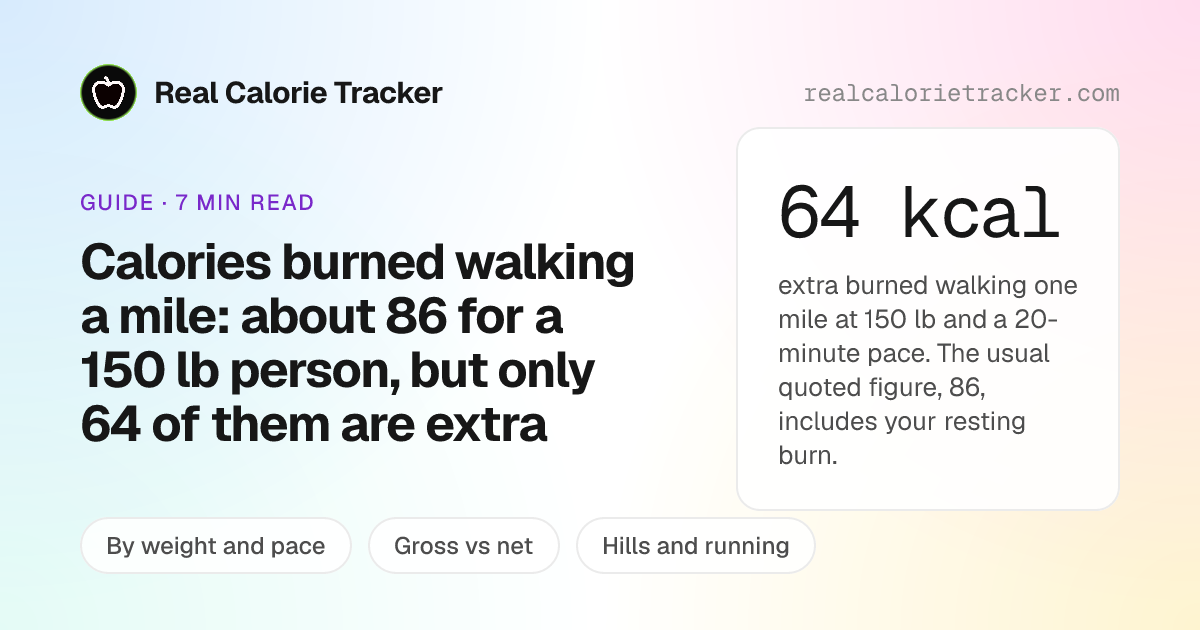
A 150 lb (68 kg) person walking a mile at an ordinary 20-minute pace burns about 86 calories in total, and about 64 more than they would have burned sitting still for those 20 minutes. The 64 is the number to use if you are counting it against food. Body weight moves both figures in proportion: at 210 lb the same mile is 121 gross and 89 extra.
Pace matters far less than people assume. Walk the mile in 15 minutes instead of 20 and the extra burn rises from 64 to 77, about 20 percent, not the doubling the effort suggests. Distance and body weight do most of the work.
Calories per mile, by body weight
Each cell is gross / net for one mile on flat ground. Gross is everything you burn while walking; net subtracts what your body would have burned at rest over the same minutes.
| Body weight | 20-minute mile (3 mph) | 15-minute mile (4 mph) | Net per km, normal pace |
|---|---|---|---|
| 120 lb (54 kg) | 69 / 51 | 75 / 61 | 32 |
| 150 lb (68 kg) | 86 / 64 | 94 / 77 | 40 |
| 180 lb (82 kg) | 103 / 76 | 112 / 92 | 47 |
| 210 lb (95 kg) | 121 / 89 | 131 / 107 | 55 |
| 240 lb (109 kg) | 138 / 102 | 150 / 122 | 63 |
| 270 lb (122 kg) | 155 / 114 | 168 / 138 | 71 |
These come from the 2024 Adult Compendium of Physical Activities, which lists level walking at 2.8 to 3.4 mph at 3.8 METs and 4.0 to 4.4 mph at 5.5 METs. One MET is roughly 1 calorie per kg of body weight per hour, so a mile costs METs × kg ÷ speed. Net uses one MET less, since one MET is what you burn at rest.
The gross figures check out against a direct measurement. In a 2012 study in the Journal of Strength and Conditioning Research, 30 adults averaging 71 kg walked 1,600 m at 3.2 mph with their oxygen use measured: they burned 372.5 kJ, which is 89 calories. The same Compendium arithmetic predicts about 85 for a 71 kg person at that speed, within 5 percent of the measurement.
For a quick rule without the table: net calories per mile ≈ 0.43 × your weight in pounds at a normal pace, and about 0.5 × pounds walking briskly. In metric, about 0.55 to 0.6 calories per kg per km. The commonly quoted “0.57 per pound” rule is the gross figure, and it is the one most calculators give you.
Why pace barely matters per mile
| Pace | Speed | METs | Gross per mile (150 lb) | Net per mile | Gross per hour |
|---|---|---|---|---|---|
| 30:00 per mile | 2.0 mph | 2.8 | 95 | 61 | 190 |
| 24:00 | 2.5 mph | 3.0 | 82 | 54 | 204 |
| 20:00 | 3.0 mph | 3.8 | 86 | 64 | 258 |
| 17:09 | 3.5 mph | 4.8 | 93 | 74 | 326 |
| 15:00 | 4.0 mph | 5.5 | 94 | 77 | 374 |
| 13:20 | 4.5 mph | 7.0 | 106 | 91 | 476 |
| 12:00 | 5.0 mph | 8.5 | 116 | 102 | 578 |
Look at the last column first: per hour, walking faster burns a lot more, which is why a brisk walk feels like exercise and a stroll does not. But per mile, the cost from 2.5 to 4 mph only moves from 54 to 77 net. When you speed up, you burn more each minute but spend fewer minutes on the mile, and the two nearly cancel.
That is the mechanism behind the ACSM walking equation used in exercise physiology, which puts the cost of level walking at a fixed amount of oxygen per kg per metre regardless of speed, across ordinary walking speeds. It works out to about 0.5 calories per kg per km net, slightly below the Compendium values. Steps are a different story, because a brisk stride covers more ground per step; that is why 10,000 steps burns noticeably more at a brisk pace even though a mile does not.
Two ends of the table break the pattern. Very slow walking (2 mph) has a higher gross cost per mile because the clock keeps running: you spend 30 minutes burning your resting calories on the way. And above about 4.5 mph walking turns inefficient. Your legs are forcing a gait that wants to become a run, and the per-mile cost climbs fast; at 5 mph a walk costs as much per mile as jogging.
Hills, running and carrying weight
These change the per-mile cost far more than pace does. For a 150 lb person:
| One mile, 150 lb (68 kg) | Net calories | How much more than a flat walk |
|---|---|---|
| Flat, 20-minute pace | 64 | baseline |
| Flat, 15-minute pace | 77 | +20% |
| Running, 10-minute mile (6 mph, 9.3 METs) | 94 | +47% |
| Walking up a steady 5% grade at 3 mph | about 113 | +77% |
| Walking up a 10% grade at 3 mph | about 162 | +153% |
The running row is from the Compendium’s 6 mph entry. The 2012 study above found the same direction: running the 1,600 m cost 113 calories against 89 for walking it, and once the 30 minutes of recovery afterwards were counted, the totals were 159 against 111. Running burns more per mile, but not twice as much, and the gap is smaller than most people think. Per half hour it is a different contest, which walking vs running for weight loss works through by body weight and by week.
The hill rows are my calculation: the flat cost plus the ACSM equation’s climbing term, which adds 1.8 ml of oxygen per kg for every metre you climb (a mile at 5 percent climbs about 80 m). A treadmill set to 10 percent more than doubles the burn of a flat mile, which is why incline walking has a reputation it deserves. Downhill is cheaper than flat, so a hilly loop that ends where it started gains less than its uphill half suggests. For straight climbing, calories burned climbing stairs works it out per floor.
A backpack works the same way as extra body weight: a 15 lb pack on a 150 lb walker adds roughly 10 percent to the cost of each mile.
What a mile pays for
At 64 net calories a mile, a 150 lb walker needs about 1.6 miles to cover a banana (105), nearly 3 miles for a samosa (185), and just over 4 miles for a glazed donut (271). That is not a reason to skip the walk. It is a reason not to treat the walk as a licence to eat; calorie deficit not working covers what eating back exercise calories does to a diet.
A walk after a big meal is the classic use for this table; Thanksgiving dinner calories puts that against a 1,600-calorie plate: at 150 lb, an easy mile after dinner covers about half a buttered roll. Over a week the numbers add up. Two miles a day, every day, at 150 lb is about 900 net calories a week. If you walk that reliably, count it once in your activity level in the TDEE calculator and do not add it back from your watch as well, because counting the same walk twice is the most common way a deficit disappears. The calorie deficit calculator turns that into a daily target, and the tracker will show you whether the food side matches it.
This guide is general information, not medical advice. If you have a heart, joint or other medical condition, or are pregnant, check with your doctor before starting a new walking routine.
This guide is general information, not medical advice. If you're pregnant, have a medical condition or take medication, talk to a doctor or registered dietitian before changing how you eat.
Written by Sheeraz Ali
Sheeraz builds Real Calorie Tracker and uses it every day. The guides come from his own food tracking and from the IFCT 2017, INDB and USDA data behind the site, with sources linked in the text.
Put it into practice
Log your first meal by grams or by serving. Free, no account needed.
More guides
- What 1,200 calories looks like: two real days, and who should not eat it
Two full 1,200-calorie days, Western (131 g protein) and Indian veg (68 g), item by item. Plus the maths on who 1,200 suits and why most men should skip it.
- What 1,500 calories looks like in a day: three real menus
Three full days at 1,500 calories, Western, Indian vegetarian and Indian non-veg, meal by meal with calories and protein for every item. Plus how to tell whether 1,500 is the right number for you.
- What 1,800 calories looks like: three real days, and who it is a diet for
Three full 1,800-calorie days, home-cooked (137 g protein), a bought-lunch workday and Indian veg, item by item. Plus who 1,800 makes lose weight and who it makes gain.