Calories in dal per katori: moong, masoor, toor, chana, urad and dal makhani
A 150 g katori of plain dal is 75 to 175 calories, dal makhani 285. The lentil barely matters; water and tadka decide. 17 dals per katori and per 30 g raw.
By Sheeraz Ali · Published November 1, 2026 · 8 min read
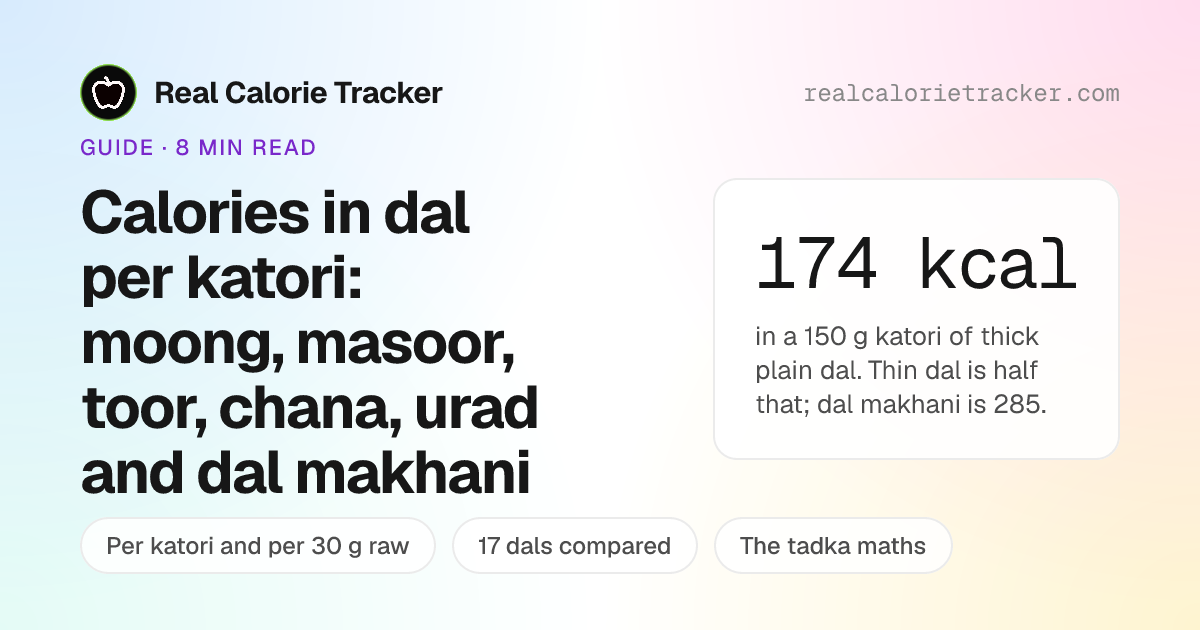
A 150 g katori of plain cooked dal is 75 to 175 calories, and the gap between those two numbers has almost nothing to do with which lentil you used. A thin, watery moong dal sits at the bottom of that range, a thick toor dal at the top. Dal makhani is 285 per katori because it is closer to a butter sauce with lentils in it. Rajma and chana masala land between 210 and 240.
The per-katori numbers below come from the Indian food database: the raw lentils from IFCT 2017, the cooked dishes from INDB’s standard home recipes, and our own entry for a thick everyday dal. Every row links to the full nutrition.
The lentil itself: every dal is about 100 calories per 30 g raw
Start here, because it kills the most common question. People ask whether moong is lighter than toor or masoor. Raw, they are the same food within a few calories.
| Dal (raw, split) | Per 100 g raw | Protein per 100 g | 30 g raw (about 2 heaped tbsp) |
|---|---|---|---|
| Moong dal (green gram, split) | 326 kcal | 23.9 g | 98 kcal, 7.2 g protein |
| Masoor dal (red lentil) | 322 kcal | 24.4 g | 97 kcal, 7.3 g protein |
| Toor / arhar dal (red gram) | 331 kcal | 21.7 g | 99 kcal, 6.5 g protein |
| Chana dal (Bengal gram) | 329 kcal | 21.6 g | 99 kcal, 6.5 g protein |
| Urad dal (black gram, split) | 324 kcal | 23.1 g | 97 kcal, 6.9 g protein |
| Whole masoor (brown) | 299 kcal | 22.5 g | 90 kcal, 6.8 g protein |
| Rajma (red kidney beans) | 299 kcal | 19.9 g | 90 kcal, 6.0 g protein |
The spread across the five split dals is 9 calories per 100 g. Masoor and moong carry two to three grams more protein per 100 g than toor and chana, which is a real but small edge. Whole dals and rajma come in slightly lower because more of their weight is fibre (rajma is about 17 g fibre per 100 g raw against 9 to 15 for the split dals).
So choose your dal for taste, digestion or price. Choosing it for calories is wasted effort.
Dal per katori: 17 versions, cooked
This is the table most people actually need. All rows are scaled to the same 150 g katori so they compare directly. The last column is the share of the dish’s calories that comes from fat, which is mostly the tadka.
| Dish | 1 katori (150 g) | Protein | Calories from fat |
|---|---|---|---|
| Washed moong dal | 75 kcal | 4.1 g | 31% |
| Arhar dal with spinach | 80 kcal | 3.2 g | 48% |
| Whole masoor | 81 kcal | 3.5 g | 42% |
| Whole moong | 81 kcal | 3.3 g | 43% |
| Horsegram dal | 84 kcal | 4.4 g | 18% |
| Washed urad dal | 92 kcal | 3.8 g | 44% |
| Mixed dal | 93 kcal | 3.8 g | 45% |
| Dal dhokli | 104 kcal | 4.5 g | 33% |
| Sambar | 146 kcal | 5.1 g | 41% |
| Chana dal (split Bengal gram) | 150 kcal | 6.3 g | 41% |
| Moti Mahal dal | 155 kcal | 5.9 g | 50% |
| Panchmel dal | 167 kcal | 6.9 g | 44% |
| Plain dal, thick (everyday) | 174 kcal | 10.5 g | 12% |
| Dry urad dal (sookhi) | 188 kcal | 10.2 g | 25% |
| Rajma curry | 210 kcal | 9.0 g | 26% |
| Chana masala | 240 kcal | 10.5 g | 28% |
| Dal makhani | 285 kcal | 10.5 g | 47% |
Two things jump out. First, the cheapest dals in the table are also the lowest in protein: a katori of washed moong dal is 75 calories but only 4 g of protein, because there is very little moong in it. Second, in most of the INDB home recipes, 40 to 50 percent of the calories are fat. In a thin dal the tadka is nearly half of what you are eating.
Why the numbers look like this
Water decides the katori. The lentil is a fixed 97 to 99 calories per 30 g raw, so a katori’s calories are really a measure of how much raw dal is in it. Working backwards from the table, a katori of thin washed moong dal holds roughly 15 g of raw dal. A thick everyday dal holds closer to 45 g. Same bowl, same lentil, three times the dal. This is why one family’s “1 katori dal” is 80 calories and another’s is 200, and why two recipe sites can disagree by 100 calories for the same dish without either being wrong.
The tadka is the variable you control. A tablespoon of ghee is 126 calories (14 g of pure fat). Split across a pot that serves four, that is about 32 calories per katori, which is modest. The trouble is that tadka is rarely measured. A pour from the jar is often two tablespoons, and a dhaba dal fry will get a second tadka on top before it is served. Restaurant dal is not in our database as its own entry, so treat this as an estimate: count a restaurant dal fry or dal tadka at 200 to 300 calories per katori, and closer to the top if you can see the ghee pooling.
Dal makhani is a different dish. Whole urad and rajma, simmered for hours, then finished with butter and cream. At 285 calories per katori with 47 percent from fat, it costs 110 calories more than a thick plain dal for exactly the same 10.5 g of protein. Treat it as a curry, not as dal, when planning a day. On a restaurant thali it is usually the single item to swap.
Rajma and chana are bean curries. They are denser than dal because the beans stay whole and the gravy is onion-tomato with oil. Per katori they give about the same protein as thick dal for 35 to 65 more calories, and roughly 50 percent more fibre. Calories in rajma chawal has rajma, chole, lobia and kadhi per katori and per plate.
How much dal you would need for your protein
Dal is the protein anchor of most vegetarian Indian meals, and it is weaker in that role than people assume, purely because of the water. ICMR-NIN’s My Plate for the Day budgets 85 g (raw) of pulses, eggs or meat across a 2,000-calorie day. If all of that came from dal, it is about 280 calories and 19 g of protein. Delivered as thin dal at 15 g of raw lentil per katori, that is five or six katoris. Delivered as thick dal, it is two.
That is the single most useful thing in this guide: make the dal thicker rather than eating more of it. You get more protein per katori and the tadka gets diluted across more lentil. The high-protein vegetarian Indian foods ranking has the options for closing the rest of the gap (paneer, soya, curd, sprouts).
The ICMR-INDIAB analysis of Indian diets published in Nature Medicine in 2025 found carbohydrates supplying about 62 percent of calories and protein only about 12 percent, and its authors recommend shifting energy from carbohydrates towards plant and dairy protein. In a dal-chawal plate, that means more dal and less chawal, not the other way round.
Logging dal you cooked yourself
Weighing the katori and picking a database entry is fine for a restaurant. At home you can be far more accurate with two numbers you already have:
- Weigh the raw dal and the ghee or oil before cooking.
- Calories in the pot = raw dal grams × 3.3 + fat grams × 9.
- Divide by the number of katoris the pot fills.
A worked example. 200 g of toor dal is 662 calories. A tadka of 15 g of ghee (a generous tablespoon) is 135. The pot is 797 calories; if it fills four katoris, each is about 200 calories and 11 g of protein. Add more water and you get five katoris of 160 each. The calories per person depend on how you split the pot, not on how long you boil it.
This is the same raw-weight logic as in cooked vs raw food weights, and it works for sambar, rajma and chole too. The vegetables in sambar add little: 100 g of drumstick or brinjal is 25 to 37 calories.
A dal meal, three ways
| Plate | Calories | Protein |
|---|---|---|
| 1 katori thick dal, 2 rotis, curd (150 g) | 502 | 23 g |
| 1 katori dal makhani, 1 naan, jeera rice (150 g) | 819 | 23 g |
| 2 katoris thick dal, 1 cup rice, salad | 573 | 26 g |
The first and third plates are what I would call a normal dal meal on a diet. The second is a restaurant order, and it costs over 300 more calories for the same protein. Rice or roti makes less difference than people think: the rice vs roti comparison has the numbers.
If you want to know how many katoris fit your day, the calorie deficit calculator gives you a target in a minute. Then log dal in the tracker by katori, or by raw grams if you cooked it, and the protein total will tell you whether one katori was enough.
Written by Sheeraz Ali
Sheeraz builds Real Calorie Tracker and uses it every day. The guides come from his own food tracking and from the IFCT 2017, INDB and USDA data behind the site, with sources linked in the text.
Put it into practice
Log your first meal by grams or by serving. Free, no account needed.
More guides
- What 1,200 calories looks like: two real days, and who should not eat it
Two full 1,200-calorie days, Western (131 g protein) and Indian veg (68 g), item by item. Plus the maths on who 1,200 suits and why most men should skip it.
- What 1,500 calories looks like in a day: three real menus
Three full days at 1,500 calories, Western, Indian vegetarian and Indian non-veg, meal by meal with calories and protein for every item. Plus how to tell whether 1,500 is the right number for you.
- What 1,800 calories looks like: three real days, and who it is a diet for
Three full 1,800-calorie days, home-cooked (137 g protein), a bought-lunch workday and Indian veg, item by item. Plus who 1,800 makes lose weight and who it makes gain.