Calories in a banana: by size, by ripeness, and why Indian bananas look higher
A medium peeled banana (118 g) is 105 calories; small 90, large 121. Indian robusta and red bananas read 124 to 132 per 118 g, partly from a different formula.
By Sheeraz Ali · Published November 16, 2026 · 7 min read
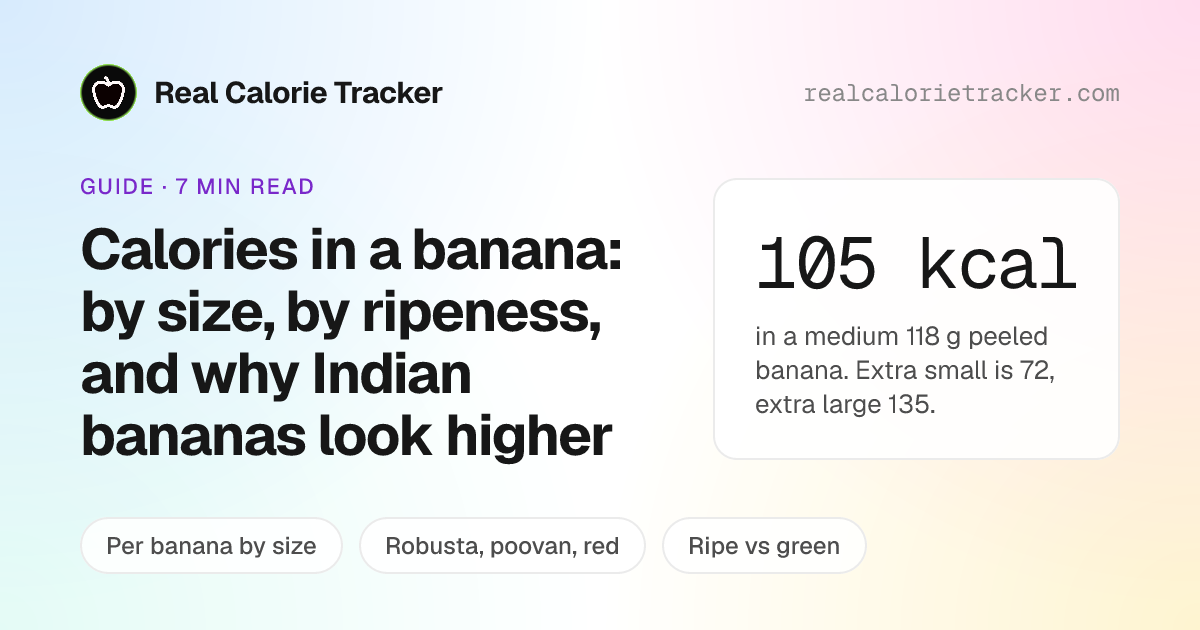
A medium banana, 7 to 8 inches long and weighing 118 g peeled, is 105 calories. A small one is 90 and a large one is 121. Across every size USDA lists, the range is 72 to 135. Nearly all of it is carbohydrate: 27 g in a medium banana, of which about 14 g is sugar and 3 g is fibre, with just over a gram of protein and almost no fat.
Those numbers come from USDA’s standard banana record (FDC 173944), which is also what our banana page uses. They’re the right numbers to log. The interesting part, if you live in India or shop at an Indian grocer, is that IFCT 2017 lists the bananas sold there at 105 to 112 calories per 100 g rather than 89, and most of that gap has nothing to do with the fruit.
Calories in a banana, by size
USDA weighs bananas peeled, so these weights are the edible part. If you weigh with the skin on, a medium banana is noticeably heavier and you’ll over-log.
| Banana | Peeled weight | Calories | Carbs | Sugar | Fibre | Protein |
|---|---|---|---|---|---|---|
| Extra small (under 6”) | 81 g | 72 | 18.5 g | 9.9 g | 2.1 g | 0.9 g |
| Small (6 to 7”) | 101 g | 90 | 23.1 g | 12.4 g | 2.6 g | 1.1 g |
| Medium (7 to 8”) | 118 g | 105 | 27.0 g | 14.4 g | 3.1 g | 1.3 g |
| Large (8 to 9”) | 136 g | 121 | 31.1 g | 16.6 g | 3.5 g | 1.5 g |
| Extra large (9” or longer) | 152 g | 135 | 34.7 g | 18.6 g | 4.0 g | 1.7 g |
| 1 cup sliced | 150 g | 134 | 34.3 g | 18.3 g | 3.9 g | 1.6 g |
| 1 cup mashed | 225 g | 200 | 51.4 g | 27.5 g | 5.9 g | 2.5 g |
The mashed cup is the one bakers miss. Two medium bananas mashed for banana bread are about 236 g, so the bananas alone put 210 calories into the loaf before any flour, sugar or butter.
A medium banana also carries 422 mg of potassium, about 9 percent of the FDA’s 4,700 mg Daily Value.
Why Indian bananas read 15 to 25 percent higher
Here’s every banana row in our data, per 100 g and scaled to the same 118 g medium banana:
| Banana | Source | Per 100 g | Per 118 g | Energy formula |
|---|---|---|---|---|
| Banana, raw | USDA SR Legacy | 89 | 105 | Fruit-specific factors |
| Banana, overripe | USDA Foundation | 85 | 100 | General 4/9/4 |
| Banana, ripe and slightly ripe | USDA Foundation | 97 | 114 | General 4/9/4 |
| Robusta (Cavendish type) | IFCT 2017 | 105 | 124 | General, fibre counted separately |
| Poovan | IFCT 2017 | 106 | 125 | General, fibre counted separately |
| Montham, ripe | IFCT 2017 | 111 | 131 | General, fibre counted separately |
| Red banana | IFCT 2017 | 112 | 132 | General, fibre counted separately |
| Raw green plantain (kachcha kela) | IFCT 2017 | 80 | 94 | General, fibre counted separately |
The USDA SR Legacy banana gets 89 because it’s calculated with fruit-specific Atwater factors: 3.36 calories per gram of protein, 8.37 per gram of fat and 3.60 per gram of carbohydrate. The 3.60 is lower than the usual 4 because fruit carbohydrate includes fibre and some sugars that yield less energy. Run the same banana through the general 4/9/4 factors and it comes out at 99, not 89. The USDA Foundation samples and IFCT both use general factors. IFCT also adds about 2 calories per gram of fibre on top.
So of the 16-calorie gap between a USDA banana (89) and an IFCT robusta (105), about 10 calories is arithmetic. The remaining 6 are real: the IFCT robusta samples carried about 2.7 g more carbohydrate per 100 g, which fits a slightly drier fruit. Red bananas are denser again.
What to log: if you track with USDA-based apps, stay with 105 for a medium banana. If you eat robusta or red bananas every day and want to be conservative, use the IFCT row for that variety. The difference is 10 to 25 calories per banana, which only matters if you eat several a day. Either way, be consistent; switching sources midway makes your log drift for no reason.
Does ripeness change the calories?
Not meaningfully. Ripening turns starch into sugar. It doesn’t create energy, and the fruit burns only a little as it respires. The USDA Foundation overripe sample came out 12 calories per 100 g lighter than the ripe one, but it also carried 2.9 g less carbohydrate, which is ordinary banana-to-banana variation, not something ripeness does.
What ripeness does change is how the carbohydrate is absorbed. Englyst and Cummings found starch made up 37 percent of the dry weight in the least ripe bananas they tested and only 3 percent in the ripest. A fully ripe banana is mostly sugar; USDA’s standard banana has only 5.4 g of starch per 100 g. Green banana starch resists digestion. In Faisant et al. 1995, 83.7 percent of the starch from raw green banana flour reached the end of the small intestine undigested, and starch that escapes digestion there provides fewer calories than its label weight suggests.
Blood sugar follows the same pattern. In a study of 10 people with type 2 diabetes, Hermansen et al. 1992 measured a glycaemic index of 43 for 120 g of under-ripe banana and 74 for the same weight over-ripe. If you watch your glucose, a firm yellow banana with a little green at the stem behaves differently from a spotty brown one, even though the calorie count is the same.
Bananas in what you actually eat
| Dish | Portion | Calories |
|---|---|---|
| Medium banana with 1 tbsp peanut butter | 118 g + 16 g | 199 |
| Home banana shake: 1 cup whole milk, medium banana, 2 tsp sugar | about 370 g | 285 |
| INDB banana milkshake | 1 tall glass (345 g) | 224 |
| Porridge: 40 g oats, 1 cup whole milk, medium banana | 1 bowl | 410 |
| Banana raita | 1 bowl (160 g) | 142 |
| Banana cake | 1 slice (66 g) | 257 |
| Green plantain, fried | 1 cup (118 g) | 365 |
The home shake and the INDB glass are 60 calories apart because the INDB recipe is thin (65 calories per 100 g, so a lot of water or ice). If your shake is made with whole milk and a full banana, use the home figure. Add a tablespoon of peanut butter and it’s 380; that’s the shake in the Indian weight gain plan, where the calories are the point.
Banana chips are a different food. USDA’s FNDDS record (FDC 2709200) is 519 calories per 100 g with 34 g of fat, so a 30 g handful is 156 calories, about one and a half fresh bananas. There’s no row for Kerala chips fried in coconut oil; I’d expect them to be close, since the fat content is what drives it.
Is a banana good for weight loss?
Yes, with one caveat. At 105 calories it’s a cheap, portable snack, and it beats almost anything in a packet. But per calorie it’s one of the denser fruits. A medium apple is 95 calories at 182 g, so you get half again as much food for fewer calories (calories in an apple has every size and variety), and an orange is 62 (calories in an orange has every size, mandarins and juice). The lowest-calorie fruits list has bananas well down the page for that reason. If you’re hungry and counting, an apple fills you more per calorie. If you’re about to train, or want something to slice into oatmeal, the banana is the better choice.
One banana counts as one of your five a day; the NHS portion guide says a portion is one piece of fruit such as an apple, banana or orange.
To log one, use the tracker, which has small, medium and large bananas built in, and the fruits group lists every fruit by calories per 100 g.
This guide is general nutrition information. If you manage diabetes, ask your doctor or dietitian how bananas fit your plan.
This guide is general information, not medical advice. If you're pregnant, have a medical condition or take medication, talk to a doctor or registered dietitian before changing how you eat.
Written by Sheeraz Ali
Sheeraz builds Real Calorie Tracker and uses it every day. The guides come from his own food tracking and from the IFCT 2017, INDB and USDA data behind the site, with sources linked in the text.
Put it into practice
Log your first meal by grams or by serving. Free, no account needed.
More guides
- What 1,200 calories looks like: two real days, and who should not eat it
Two full 1,200-calorie days, Western (131 g protein) and Indian veg (68 g), item by item. Plus the maths on who 1,200 suits and why most men should skip it.
- What 1,500 calories looks like in a day: three real menus
Three full days at 1,500 calories, Western, Indian vegetarian and Indian non-veg, meal by meal with calories and protein for every item. Plus how to tell whether 1,500 is the right number for you.
- What 1,800 calories looks like: three real days, and who it is a diet for
Three full 1,800-calorie days, home-cooked (137 g protein), a bought-lunch workday and Indian veg, item by item. Plus who 1,800 makes lose weight and who it makes gain.