High-fiber foods ranked by fiber per 100 calories, and the 1.4 g line that matters
45 foods ranked by grams of fiber per 100 calories. Raspberries give 12.5 g, lentils 6.8, oats 2.7, almonds 2.2. Anything above 1.4 g pulls you toward 28 g a day.
By Sheeraz Ali · Published November 6, 2026 · 8 min read
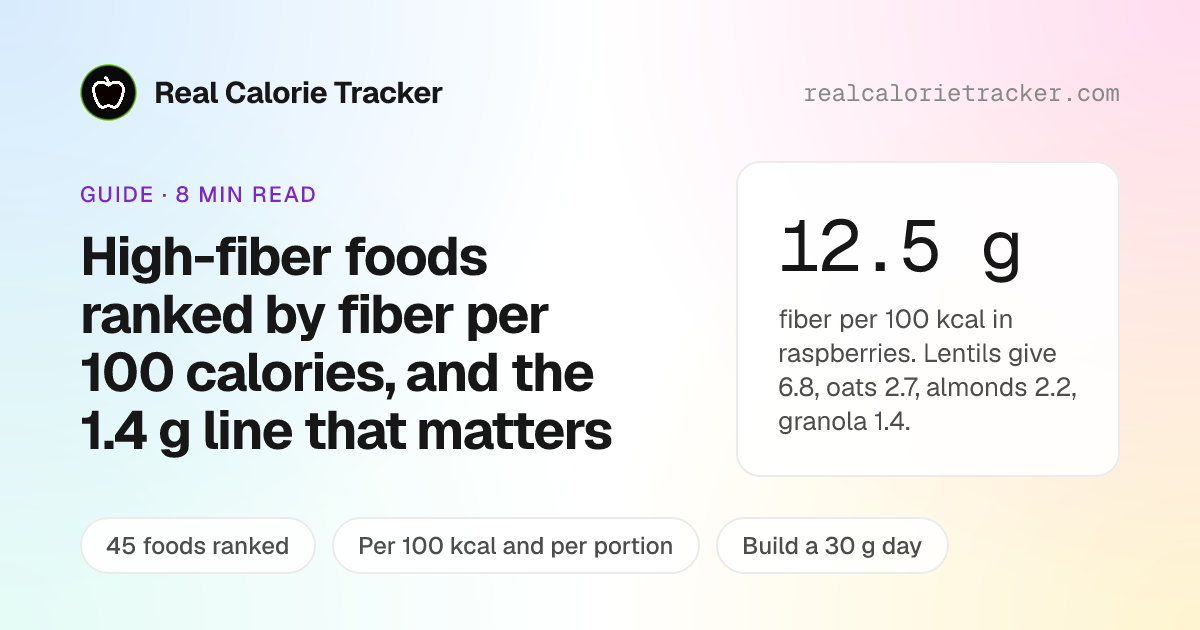
The foods with the most fiber per calorie are berries, leafy and green vegetables, and beans. Raspberries and blackberries give about 12.5 g of fiber per 100 calories, green beans 11, broccoli 7.6, lentils 6.8. Oats give 2.7, almonds 2.2 and granola 1.4, which is why a breakfast of granola and nuts can be called “high fiber” on the box and still leave you far short for the day.
The ranking below is per 100 calories rather than per 100 g, because if you are trying to lose weight, calories are what you are rationing. Chia seeds have 34 g of fiber per 100 g and raspberries have 6.5, but per calorie they are close to a tie, and the raspberries come with a cup of volume in your stomach. Values are USDA figures from the food database; each food links to its page.
The 1.4 g line
The US Dietary Guidelines set fiber at 14 g per 1,000 calories, which the Academy of Nutrition and Dietetics translates to 25 g a day for adult women and 38 g for men. The FDA Daily Value on labels is 28 g.
Divide that by ten and you get the most useful number in this guide: 1.4 g of fiber per 100 calories. Every food above that line pulls your day toward the target. Every food below it pulls you away, however healthy its reputation. A day built mostly from foods under the line cannot reach 28 g without far more calories than you want to eat. Fewer than 3 percent of Americans meet the recommendation, according to an analysis of NHANES data, and the reason is that most of what people eat (meat, dairy, white bread, pasta, cheese, sweets) sits at or near zero.
The ranking
| Food | Fiber per 100 kcal | Per 100 g | A real portion |
|---|---|---|---|
| Wheat bran | 19.8 g | 42.8 g, 216 kcal | 2 tbsp (7 g): 3 g, 15 kcal |
| Raspberries | 12.5 g | 6.5 g, 52 kcal | 1 cup (123 g): 8 g, 64 kcal |
| Collard greens | 12.5 g | 4.0 g, 32 kcal | 1 cup chopped (36 g): 1.4 g, 12 kcal |
| Blackberries | 12.3 g | 5.3 g, 43 kcal | 1 cup (144 g): 7.6 g, 62 kcal |
| Eggplant | 12.0 g | 3.0 g, 25 kcal | 1 cup cubed (82 g): 2.5 g, 21 kcal |
| Artichoke | 11.5 g | 5.4 g, 47 kcal | 1 medium (128 g): 6.9 g, 60 kcal |
| Green beans | 11.0 g | 3.4 g, 31 kcal | 1 cup (100 g): 3.4 g, 31 kcal |
| Asparagus | 10.5 g | 2.1 g, 20 kcal | 1 cup (134 g): 2.8 g, 27 kcal |
| Cabbage | 10.0 g | 2.5 g, 25 kcal | 1 cup shredded (89 g): 2.2 g, 22 kcal |
| Spinach, raw | 9.6 g | 2.2 g, 23 kcal | 1 cup (30 g): 0.7 g, 7 kcal |
| Brussels sprouts | 8.8 g | 3.8 g, 43 kcal | 1 cup (88 g): 3.3 g, 38 kcal |
| Cauliflower | 8.0 g | 2.0 g, 25 kcal | 1 cup chopped (107 g): 2.1 g, 27 kcal |
| Broccoli | 7.6 g | 2.6 g, 34 kcal | 1 cup chopped (91 g): 2.4 g, 31 kcal |
| Kale, raw | 7.3 g | 3.6 g, 49 kcal | 1 cup chopped (67 g): 2.4 g, 33 kcal |
| Chia seeds | 7.1 g | 34.4 g, 486 kcal | 1 tbsp (12 g): 4.1 g, 58 kcal |
| Green peas | 7.0 g | 5.7 g, 81 kcal | 1 cup (145 g): 8.3 g, 117 kcal |
| Carrot | 6.8 g | 2.8 g, 41 kcal | 1 medium (61 g): 1.7 g, 25 kcal |
| Red bell pepper | 6.8 g | 2.1 g, 31 kcal | 1 medium (119 g): 2.5 g, 37 kcal |
| Lentils, cooked | 6.8 g | 7.9 g, 116 kcal | 1 cup (198 g): 15.6 g, 230 kcal |
| Black beans, cooked | 6.6 g | 8.7 g, 132 kcal | 1 cup (172 g): 15 g, 227 kcal |
| Parsnips | 6.5 g | 4.9 g, 75 kcal | 1 cup sliced (133 g): 6.5 g, 100 kcal |
| Pinto beans, cooked | 6.3 g | 9.0 g, 143 kcal | 1 cup (171 g): 15.4 g, 245 kcal |
| Strawberries | 6.3 g | 2.0 g, 32 kcal | 1 cup (152 g): 3 g, 49 kcal |
| Pear | 5.4 g | 3.1 g, 57 kcal | 1 medium (178 g): 5.5 g, 101 kcal |
| Flaxseed | 5.1 g | 27.3 g, 534 kcal | 1 tbsp (10 g): 2.7 g, 53 kcal |
| Orange | 5.1 g | 2.4 g, 47 kcal | 1 medium (131 g): 3.1 g, 62 kcal |
| Kidney beans, cooked | 5.0 g | 6.4 g, 127 kcal | 1 cup (177 g): 11.3 g, 225 kcal |
| Kiwi | 4.9 g | 3.0 g, 61 kcal | 1 fruit (69 g): 2.1 g, 42 kcal |
| Apple | 4.6 g | 2.4 g, 52 kcal | 1 medium (182 g): 4.4 g, 95 kcal |
| Chickpeas, cooked | 4.6 g | 7.6 g, 164 kcal | 1 cup (164 g): 12.5 g, 269 kcal |
| Edamame | 4.3 g | 5.2 g, 121 kcal | 1 cup (155 g): 8.1 g, 188 kcal |
| Avocado | 4.2 g | 6.7 g, 160 kcal | ½ avocado (68 g): 4.6 g, 109 kcal |
| Blueberries | 4.2 g | 2.4 g, 57 kcal | 1 cup (148 g): 3.6 g, 84 kcal |
| Dried figs | 3.9 g | 9.8 g, 249 kcal | 3 figs (40 g): 3.9 g, 100 kcal |
| Popcorn, air-popped | 3.9 g | 15 g, 387 kcal | 3 cups (24 g): 3.6 g, 93 kcal |
| Sweet potato, baked | 3.7 g | 3.3 g, 90 kcal | 1 medium (114 g): 3.8 g, 103 kcal |
| Barley, cooked | 3.1 g | 3.8 g, 123 kcal | 1 cup (157 g): 6 g, 193 kcal |
| Prunes | 3.0 g | 7.1 g, 240 kcal | 4 to 5 prunes (40 g): 2.8 g, 96 kcal |
| Banana | 2.9 g | 2.6 g, 89 kcal | 1 medium (118 g): 3.1 g, 105 kcal |
| Whole-wheat bread | 2.8 g | 7.0 g, 247 kcal | 1 slice (32 g): 2.2 g, 79 kcal |
| Oats, dry | 2.7 g | 10.6 g, 389 kcal | ½ cup (40 g): 4.2 g, 156 kcal |
| Quinoa, cooked | 2.3 g | 2.8 g, 120 kcal | 1 cup (185 g): 5.2 g, 222 kcal |
| Almonds | 2.2 g | 12.5 g, 579 kcal | 1 oz (28 g): 3.5 g, 162 kcal |
| Granola | 1.4 g | 7.0 g, 489 kcal | ½ cup (61 g): 4.3 g, 298 kcal |
| Brown rice, cooked | 1.3 g | 1.6 g, 123 kcal | 1 cup (195 g): 3.1 g, 240 kcal |
How to read it
Above 6 g per 100 kcal: the foods that make the target easy. Berries, green vegetables, cabbage-family vegetables and beans. Two cups of raspberries alone are 16 g of fiber for 128 calories. The catch with the leafy end of the list is volume: spinach has a superb ratio, but a cup of raw leaves is 0.7 g. You would need 40 cups to reach the target. Ratio tells you what is efficient; the portion column tells you what is practical.
Beans and lentils are the real workhorses. They sit at 5 to 7 g per 100 kcal, but because a normal serving is a full cup, they deliver 11 to 16 g in one bowl, more than half the daily target. No other food on the list does that in a portion people actually eat. A cup of lentils also carries 18 g of protein, which is why they turn up on the highest-protein foods per calorie list as well.
Between 1.4 and 4 g: helpful, not decisive. Oats, whole-wheat bread, barley, sweet potato, banana, avocado. Swapping white bread (1.0 g per 100 kcal) for whole wheat (2.8) nearly triples the fiber for the same calories, which is worth doing, but two slices still only give you 4.4 g.
At or under the line, despite the label. Brown rice at 1.3 is barely ahead of the 1.4 average a day needs; the difference from white rice (a cup of brown has 3.1 g against well under 1 g) is real but small, and our rice vs roti comparison makes the same point for Indian staples. Brown rice vs white rice covers what the bran does change: blood sugar, diabetes risk and arsenic. Granola sits exactly on the line because its oats are diluted with sugar and oil. Nuts (almonds 2.2, walnuts 1.0, peanut butter 1.0) are fat foods with some fiber attached.
Why some foods win
Fiber is the part of a plant cell wall your gut cannot digest, so it adds bulk but almost no calories. The foods at the top are the ones that are mostly cell wall and water: a raspberry is 86 percent water and its seeds are almost pure fiber, while eggplant and green beans are scaffolding with very little starch or sugar stored inside. As soon as a plant stores energy, whether as starch (potatoes, rice, grains), sugar (bananas, mangoes, dried fruit) or oil (nuts, seeds, avocado), the calories climb and the ratio drops. Avocado still gives 4.6 g in half a fruit, but at 114 calories, and USDA’s newer Hass sample reads higher again (calories in an avocado explains why).
Processing finishes the job. Milling wheat into white flour removes the bran, which is why wheat bran tops this list at 19.8 and white bread sits at 1.0. Juicing an orange removes the pulp and leaves the sugar. Drying fruit does not remove fiber, but it removes the water that made you stop eating: three dried figs are 100 calories, about the same as a fresh pear, and gone in four bites. Calories in a pear shows the same jump for dried pear halves, at 4.6 times the calories per gram.
Chia and flax are the exception among seeds. They are oily, but so much of their mass is fiber (34 g and 27 g per 100 g) that they still clear 5 g per 100 kcal. A tablespoon of chia in yogurt is 4 g of fiber for 58 calories, the cheapest top-up on the list.
30 g of fiber for under 400 calories
You do not have to eat a salad bowl the size of your head. This set of additions, layered onto whatever you already eat, adds about 30 g, more than the FDA’s 28 g on its own:
| Addition | Calories | Fiber |
|---|---|---|
| 1 tbsp chia seeds in yogurt or oats | 58 | 4.1 g |
| 1 cup raspberries or blackberries | 64 | 8.0 g |
| ½ cup black beans in a lunch bowl, salad or burrito | 114 | 7.5 g |
| 1 medium pear or apple as a snack | 95 to 101 | 4.4 to 5.5 g |
| 1 cup broccoli or Brussels sprouts with dinner | 31 to 38 | 2.4 to 3.3 g |
| 2 slices whole-wheat bread instead of white | +10 over white | +2.9 g over white |
| Total | ≈ 370 to 385 | ≈ 29 to 31 g added |
That is the whole trick: two fruit servings, a half cup of beans, a spoon of seeds and a vegetable at dinner. In the POUNDS Lost trial, 345 adults on calorie-restricted diets who raised their fiber by an average of 3.7 g a day lost 1.4 kg more over six months, whatever the diet’s macro split. Fiber was the strongest predictor of weight loss in the model, and higher fiber went with better adherence to the assigned diet. Three of the additions above cover that 3.7 g twice over.
Go up slowly
Going from 15 g to 35 g overnight is a reliable way to spend a weekend bloated. Add one item from the table every few days, drink with it, and give your gut two or three weeks. Beans in particular are easier on the stomach in half-cup portions at first. The how much fiber per day guide covers the targets by age and sex; if you eat mostly Indian food, the high-fiber Indian foods ranking does the same job for dals, millets and sabzi.
To see where you actually are, log one normal day in the tracker, which shows fiber next to calories and protein. If you land in the teens, a cup of berries and a cup of beans closes most of the gap. If you are still setting a calorie target, the calorie deficit calculator takes a minute.
This guide is general information, not medical advice. If you're pregnant, have a medical condition or take medication, talk to a doctor or registered dietitian before changing how you eat.
Written by Sheeraz Ali
Sheeraz builds Real Calorie Tracker and uses it every day. The guides come from his own food tracking and from the IFCT 2017, INDB and USDA data behind the site, with sources linked in the text.
Put it into practice
Log your first meal by grams or by serving. Free, no account needed.
More guides
- What 1,200 calories looks like: two real days, and who should not eat it
Two full 1,200-calorie days, Western (131 g protein) and Indian veg (68 g), item by item. Plus the maths on who 1,200 suits and why most men should skip it.
- What 1,500 calories looks like in a day: three real menus
Three full days at 1,500 calories, Western, Indian vegetarian and Indian non-veg, meal by meal with calories and protein for every item. Plus how to tell whether 1,500 is the right number for you.
- What 1,800 calories looks like: three real days, and who it is a diet for
Three full 1,800-calorie days, home-cooked (137 g protein), a bought-lunch workday and Indian veg, item by item. Plus who 1,800 makes lose weight and who it makes gain.