Brown rice vs white rice for weight loss: 7 calories apart, and what actually differs
Cooked brown rice is 123 calories per 100 g, white is 130. For weight loss the gap is trivial; the real differences are fibre (4x), blood sugar and arsenic. The numbers.
By Sheeraz Ali · Published November 7, 2026 · 7 min read
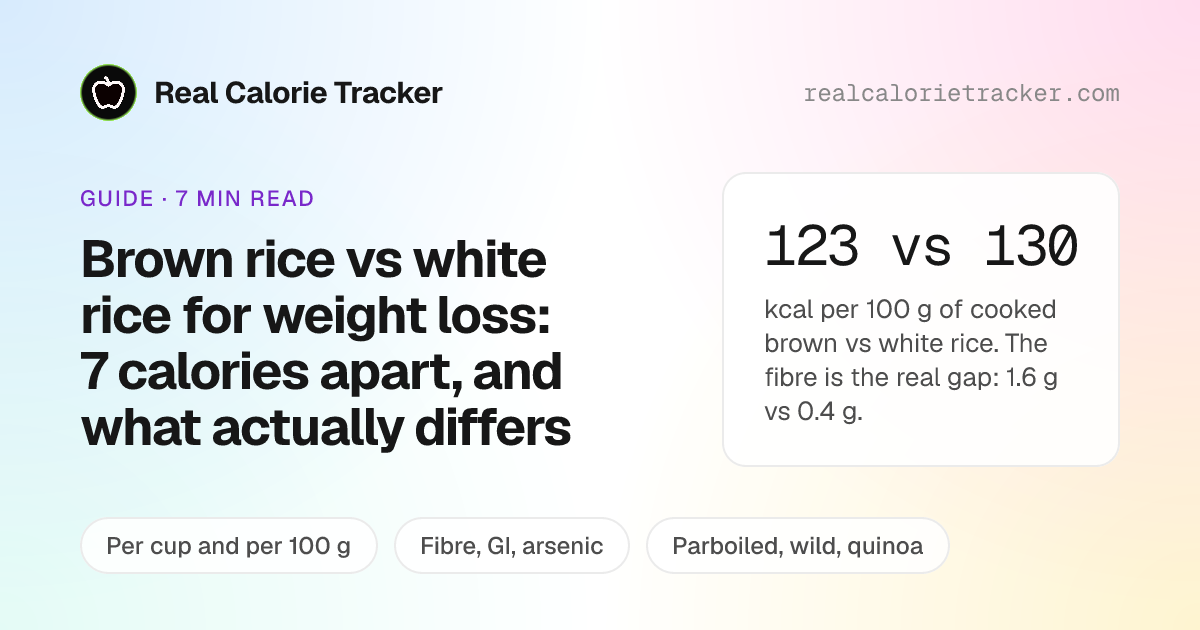
For weight loss, brown rice and white rice are close to a tie. Cooked, brown rice is 123 calories per 100 g and white rice is 130. Per cup, brown rice is actually 35 calories higher (240 against 205), because a cup of brown rice packs more grain. Neither difference will move your weight. What you are really choosing between is fibre, a modest difference in blood sugar response, and a long-term diabetes risk that has decent evidence behind it. Brown rice wins all three, and it is worth eating if you like it. It will not do the work of a smaller portion.
The values are from the food database: our USDA-based cooked rice entries, and raw grain values from IFCT 2017. There is also a side-by-side brown rice vs white rice comparison page with the full breakdown.
The numbers, cooked
| Rice | Per cup | Calories | Protein | Carbs | Fibre |
|---|---|---|---|---|---|
| White rice | 1 cup (158 g) | 205 | 4.3 g | 44.6 g | 0.6 g |
| Brown rice | 1 cup (195 g) | 240 | 5.3 g | 49.9 g | 3.1 g |
| Wild rice | 1 cup (164 g) | 166 | 6.6 g | 34.9 g | 3.0 g |
| Quinoa | 1 cup (185 g) | 222 | 8.1 g | 39.4 g | 5.2 g |
| Boiled rice (INDB) | 1 plate (300 g) | 351 | 7.8 g | 77.1 g | 3.6 g |
Look at the per-cup weights before the calories. A cup of brown rice in the USDA data weighs 195 g and a cup of white weighs 158 g. A cup is a volume, and the firmer, intact brown grains settle into it more densely. That is the entire reason brown rice “has more calories” in apps that log by the cup. By weight, brown is slightly lower.
The INDB row is there because it is how a lot of people actually eat rice: a 300 g plate, nearly two cups. Whatever colour it is, that plate is 350 to 390 calories before anything goes on it.
Raw, before the water
Cooked numbers depend on how much water the rice absorbs, which varies by grain and by cook. Raw numbers do not. Here are IFCT’s values for the three kinds of rice sold in Indian shops, per 100 g and per 75 g, a typical one-person dry portion.
| Raw rice (IFCT 2017) | Per 100 g | Protein | Fibre | 75 g dry portion |
|---|---|---|---|---|
| White (milled) | 356 kcal | 7.9 g | 2.8 g | 267 kcal, 2.1 g fibre |
| Parboiled (milled) | 352 kcal | 7.8 g | 3.7 g | 264 kcal, 2.8 g fibre |
| Brown | 354 kcal | 9.2 g | 4.4 g | 266 kcal, 3.3 g fibre |
Three calories apart per 75 g. If you weigh rice raw (I do, because the cooked weight changes with every pot), the colour of the rice makes no difference to your log. IFCT measures total dietary fibre and finds more in every grain than USDA does, which is why white rice shows 2.8 g here and 0.4 g cooked above. The ranking is the same either way: brown has about 1.5 times the fibre of white in IFCT and 4 times in USDA.
Parboiled rice (sela, ukda, the default in much of South and East India) sits between the two. It is soaked and steamed in the husk before milling, which drives some of the bran’s nutrients into the grain. Basmati and jasmine are not in our database as separate rows; per 100 g raw they are white rice for logging purposes.
What the bran actually changes
Brown rice is white rice with the bran and germ still on. Milling removes them, and with them goes most of the fibre, the small amount of fat (1.0 g per 100 g cooked against 0.3 g, from the bran oil), and a share of the magnesium and B vitamins. The starch inside is the same starch.
Fibre and fullness. A cup of brown rice has 2.5 g more fibre than a cup of white. That is real but small: a medium apple has 4.4 g. If your goal is to feel full on fewer calories, brown rice helps a little; adding a katori of dal or a side of vegetables helps a lot more. The high-fiber foods per calorie ranking shows how far down the list either rice sits.
Blood sugar. The international glycemic index tables (Atkinson et al., Diabetes Care, 2008) give boiled white rice a GI of 73 and brown rice 68. Both count as high. The difference is real and modest, and it shrinks further once the rice is eaten with dal, curd or vegetables, which slow digestion of the whole meal.
Diabetes risk over years. This is where the evidence favours brown rice. In three large US cohorts covering nearly 200,000 people, Sun et al. (Archives of Internal Medicine, 2010) found that eating white rice five or more times a week was associated with a 17 percent higher risk of type 2 diabetes than eating it less than once a month, while two or more servings of brown rice a week was associated with an 11 percent lower risk. Swapping 50 g a day of cooked white rice for brown was associated with a 16 percent lower risk. A 2012 BMJ meta-analysis found risk rising about 11 percent for each daily serving of white rice, and much more steeply in Chinese and Japanese populations who ate three to four servings a day. These are observational studies, so they show association, not proof, but the direction is consistent.
For Indian eaters the amount matters as much as the colour. The ICMR-INDIAB analysis discussed in rice vs roti found that swapping refined cereals for whole grains without eating less carbohydrate overall was not linked to lower diabetes odds. Brown rice by the plateful is still a plateful.
Arsenic. Rice takes up arsenic from paddy water, and it concentrates in the bran, so brown rice carries more. The FDA’s guidance on arsenic in food is to eat a varied diet rather than avoid rice. A practical fix exists: cooking rice in excess water and draining it, the draining method many Indian kitchens still use, cut inorganic arsenic by 50 percent in brown rice and 40 percent in polished rice in an FDA-led study (Gray et al., 2016). It also washed out 50 to 70 percent of the added iron and B vitamins in enriched white rice, so if your pack says enriched or fortified, that trade-off applies to you.
What actually changes the calories on your plate
| The same meal with | White rice | Brown rice |
|---|---|---|
| 1 katori (150 g) | 195 kcal, 0.6 g fibre | 185 kcal, 2.4 g fibre |
| 1 plate (300 g) | 390 kcal, 1.2 g fibre | 369 kcal, 4.8 g fibre |
| Cutting the plate to a katori | saves 195 kcal | saves 184 kcal |
The colour saves 10 to 20 calories. The portion saves 185 to 195. That is the whole case. If brown rice helps you serve less because it is chewier and fills you sooner, it is helping. If you eat the same 300 g plate and feel virtuous about it, it is not.
My rules: weigh rice raw, 60 to 75 g a person for a meal with a protein side; use whichever rice you enjoy; and if you eat rice twice a day, make one of them brown or parboiled for the fibre and the long-term evidence. If you are choosing for taste between brown rice and quinoa, quinoa gives 8 g of protein a cup against 5, for 18 fewer calories; quinoa vs rice ranks eight grains per cup and per 50 g raw. Wild rice is lighter again at 166 a cup with 6.6 g of protein; it is the seed of a different grass (Zizania), not a rice at all.
To find the portion that fits your day, start with the calorie deficit calculator, then log rice by raw weight in the tracker. The cooked vs raw food weights guide has the conversion if you only have the cooked number.
This guide is general nutrition information, not medical advice. If you have diabetes or prediabetes, ask your doctor or dietitian how rice fits your plan.
This guide is general information, not medical advice. If you're pregnant, have a medical condition or take medication, talk to a doctor or registered dietitian before changing how you eat.
Written by Sheeraz Ali
Sheeraz builds Real Calorie Tracker and uses it every day. The guides come from his own food tracking and from the IFCT 2017, INDB and USDA data behind the site, with sources linked in the text.
Put it into practice
Log your first meal by grams or by serving. Free, no account needed.
More guides
- What 1,200 calories looks like: two real days, and who should not eat it
Two full 1,200-calorie days, Western (131 g protein) and Indian veg (68 g), item by item. Plus the maths on who 1,200 suits and why most men should skip it.
- What 1,500 calories looks like in a day: three real menus
Three full days at 1,500 calories, Western, Indian vegetarian and Indian non-veg, meal by meal with calories and protein for every item. Plus how to tell whether 1,500 is the right number for you.
- What 1,800 calories looks like: three real days, and who it is a diet for
Three full 1,800-calorie days, home-cooked (137 g protein), a bought-lunch workday and Indian veg, item by item. Plus who 1,800 makes lose weight and who it makes gain.