Rice vs roti for weight loss: calories, protein and fibre at the same 200 calories
Two rotis are 238 calories, a cup of rice 205. At equal calories roti gives 50% more protein and 5x the fibre, but the portion on your plate matters more.
By Sheeraz Ali · Published November 1, 2026 · 8 min read
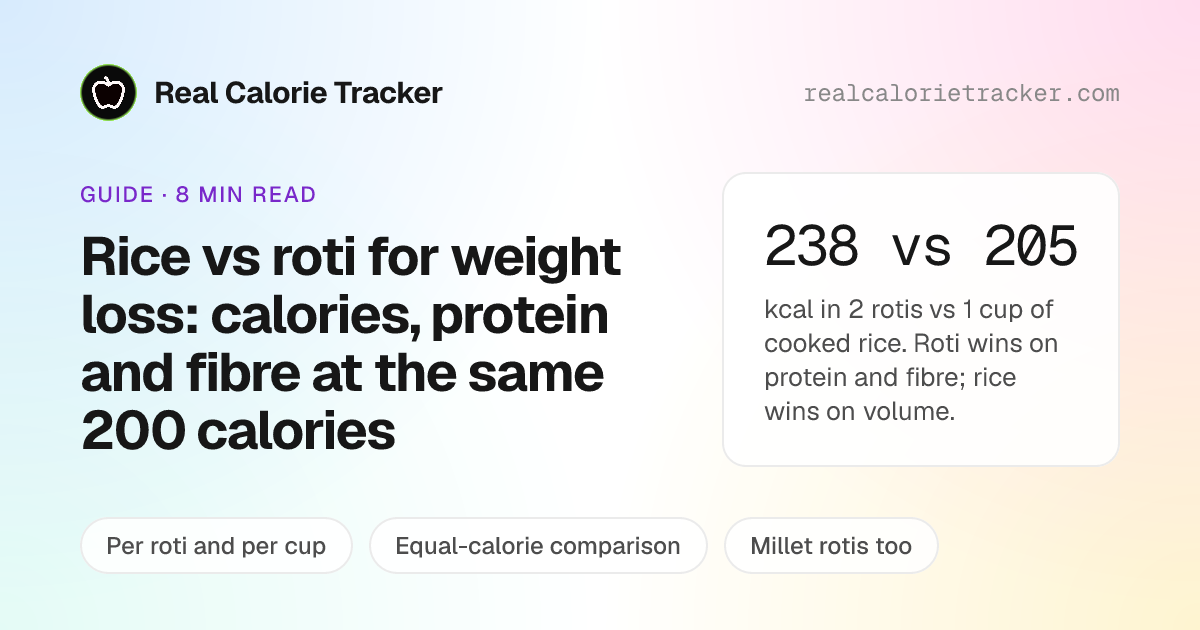
Roti is the better choice for weight loss, but by less than the internet claims. Two medium rotis are 238 calories and one cup of cooked white rice is 205. At the same 200 calories, roti gives you about 6.5 g of protein and 3.3 g of fibre against rice’s 4.2 g and 0.6 g. That is a real edge, worth having. It is also much smaller than the difference between one cup of rice and the 300 g mound most people actually serve themselves.
The numbers here come from the Indian food database: our everyday roti and rice entries (USDA-based), INDB’s plain phulka and boiled rice, and raw flours from IFCT 2017. There is also a side-by-side roti vs white rice comparison page if you want the full macro breakdown.
Per portion: what you actually log
| Food | Portion | Calories | Protein | Fibre |
|---|---|---|---|---|
| Roti / chapati | 1 medium (40 g) | 119 | 3.8 g | 2.0 g |
| Roti / chapati | 2 medium (80 g) | 238 | 7.7 g | 3.9 g |
| Phulka, plain (INDB) | 1 (36 g) | 73 | 2.1 g | 2.3 g |
| White rice, cooked | 1 cup (158 g) | 205 | 4.3 g | 0.6 g |
| Brown rice, cooked | 1 cup (195 g) | 240 | 5.3 g | 3.1 g |
| Boiled rice (INDB) | 1 plate (300 g) | 351 | 7.8 g | 3.6 g |
Notice the two roti rows disagree. Our standard 40 g roti is 119 calories and carries 2.9 g of fat, which is what you get when the dough has a little oil or the roti is brushed after cooking. INDB’s plain phulka, puffed on the flame with no fat, is 73 calories for 36 g. If your rotis come off the tawa dry, log the phulka. If there is ghee on them, log the standard roti and add 45 calories for each teaspoon of ghee.
The rice rows disagree too, in a different way: INDB’s plate is 300 g. That is nearly two cups, and it is a realistic lunch serving in a lot of homes.
At equal calories: the fair comparison
Gram for gram, roti is 297 calories per 100 g and rice is 130, which is why “roti has more calories than rice” circulates as often as the opposite claim. Neither framing helps, because nobody eats rice and roti by the same weight. The useful question is what you get for the same calorie budget.
| 200 calories of | Weight | Protein | Fibre |
|---|---|---|---|
| Roti | 67 g (1.7 rotis) | 6.5 g | 3.3 g |
| Phulka, plain | 99 g (2.7 phulkas) | 5.8 g | 6.2 g |
| White rice, cooked | 154 g (1 cup) | 4.2 g | 0.6 g |
| Brown rice, cooked | 163 g (0.8 cup) | 4.4 g | 2.6 g |
| Atta (wheat flour), raw | 63 g | 6.6 g | 7.1 g |
| Rice, milled, raw | 56 g | 4.4 g | 1.6 g |
Roti delivers about 50 percent more protein than white rice at the same calories, and five times the fibre by our USDA-based figures. (IFCT measures more fibre in both foods than USDA does, so the raw-flour rows show a smaller but still large gap: 7.1 g against 1.6 g.) Brown rice closes most of the fibre gap and none of the protein gap; brown rice vs white rice has the rest of that comparison.
Rice has one honest advantage: volume. Cooked rice is about two thirds water, so 200 calories of it is 154 g of food on the plate against 67 g of roti. If you are someone who needs a full-looking plate, a measured cup of rice can feel like more food than one and a half rotis.
Why the difference exists
Whole grain against polished grain. Atta is whole wheat, bran and germ included, which is where its fibre and some of its protein live. White rice has had the bran polished off. Raw, rice is actually the more calorie-dense of the two (356 against 320 per 100 g in IFCT), so roti’s lower calorie count per serving is not because wheat is “lighter”. It is because a roti uses about 30 g of flour and a cup of rice uses about 58 g of raw rice.
Water. Cooking adds water to both, but much more to rice. A cup of cooked rice is roughly a third rice and two thirds water by weight, which is why per-100 g comparisons flip depending on whether you compare raw or cooked. The guide to cooked vs raw food weights has the conversion factors.
Countability. This is the one I think matters most, and it is behavioural rather than nutritional. Rotis come in units. You know whether you had two or four. Rice comes from a pot with a big spoon, and a “plate” of rice drifts from 150 g to 350 g without anyone noticing. If you switch from rice to roti and lose weight, a good part of the reason is often that you started counting.
Does switching to roti or millets help on its own?
Probably less than people hope. The ICMR-INDIAB analysis of more than 18,000 Indian adults, published in Nature Medicine in 2025, found that carbohydrates supply about 62 percent of calories in the average Indian diet. Replacing refined cereals such as white rice with whole wheat or millet flour, without reducing total carbohydrate, was not associated with lower odds of type 2 diabetes. What was associated with lower risk was eating less carbohydrate overall and more plant and dairy protein. This was a cross-sectional study, so it shows associations, but the direction is clear: the swap is not the lever, the amount is.
ICMR-NIN’s My Plate for the Day budgets about 250 g of cereals (raw weight) for a 2,000-calorie day. That is roughly eight rotis’ worth of atta, or a little over four cups of cooked rice, for the whole day. If lunch alone is a 300 g plate of rice plus two rotis, you have used about two thirds of it in one meal. If you count carbs for diabetes, the printable carb chart for Indian food puts rice, roti, dal and 55 other foods in carb choices per katori or piece.
The other breads and rice dishes
Once fat enters the picture, the rice-versus-roti question stops mattering. A single aloo paratha is more than two plain rotis.
| Food | Portion | Calories | Protein |
|---|---|---|---|
| Methi thepla | 1 (36 g) | 125 | 3.2 g |
| Makki ki roti | 1 (85 g) | 224 | 3.0 g |
| Naan | 1 (90 g) | 279 | 7.8 g |
| Aloo paratha | 1 (100 g) | 280 | 5.5 g |
| Veg pulao | 1 cup (150 g) | 225 | 5.3 g |
| Khichdi | 1 bowl (200 g) | 240 | 8.0 g |
| Jeera rice | 1 cup (150 g) | 255 | 4.5 g |
| Curd rice | 1 plate (215 g) | 421 | 12.5 g |
| Lemon rice | 1 plate (320 g) | 563 | 13.8 g |
Jeera rice is 60 calories more than the same 150 g of plain rice, all of it ghee or oil. Lemon rice gets 40 percent of its calories from fat, mostly the oil and peanuts in the tempering. Khichdi is the best rice dish on the list for weight loss: the dal raises the protein to 8 g a bowl, and more if you shift the ratio toward dal, as the khichdi guide shows. Pulao depends almost entirely on what goes in with the rice: a plate of matar pulao is 512 calories and peanut pulao 695, and calories in pulao weighs eleven of them.
Jowar, bajra and ragi rotis are not in our database as cooked dishes. Estimated from IFCT flour values, a roti made from 30 g of jowar, bajra or ragi flour is 96 to 104 calories before any fat, which is the same as a wheat roti. Bajra and jowar carry about the same protein and fibre as atta; ragi has less protein. Choose millets for variety and taste. Their calories are not lower.
Four plates, same dal and sabzi
Each plate has one katori of dal (174) and one katori of spinach and potato (86). Only the grain changes.
| Grain on the plate | Total calories | Protein |
|---|---|---|
| 1 cup white rice | 465 | 17 g |
| 2 rotis, no ghee | 498 | 21 g |
| 300 g plate of rice | 650 | 21 g |
| 2 rotis and 1 cup rice | 703 | 25 g |
The first two plates are within 35 calories of each other. The last two are the ones that stall a diet: the heaped rice plate and the “a little rice after the rotis” habit each add around 200 calories to an otherwise identical meal. The rule that works is one grain per meal, measured: two rotis or one cup of rice, never both. Which one you pick is a matter of taste. The thali guide uses the same rule for the full plate, and the calories in dal guide covers the other half of a dal-chawal lunch.
To see what one cup of rice or two rotis means against your own day, get a target from the calorie deficit calculator, then log a normal lunch in the tracker by grams for a week. The rice spoon is usually where the missing calories turn up.
This guide is general information, not medical advice. If you're pregnant, have a medical condition or take medication, talk to a doctor or registered dietitian before changing how you eat.
Written by Sheeraz Ali
Sheeraz builds Real Calorie Tracker and uses it every day. The guides come from his own food tracking and from the IFCT 2017, INDB and USDA data behind the site, with sources linked in the text.
Put it into practice
Log your first meal by grams or by serving. Free, no account needed.
More guides
- What 1,200 calories looks like: two real days, and who should not eat it
Two full 1,200-calorie days, Western (131 g protein) and Indian veg (68 g), item by item. Plus the maths on who 1,200 suits and why most men should skip it.
- What 1,500 calories looks like in a day: three real menus
Three full days at 1,500 calories, Western, Indian vegetarian and Indian non-veg, meal by meal with calories and protein for every item. Plus how to tell whether 1,500 is the right number for you.
- What 1,800 calories looks like: three real days, and who it is a diet for
Three full 1,800-calorie days, home-cooked (137 g protein), a bought-lunch workday and Indian veg, item by item. Plus who 1,800 makes lose weight and who it makes gain.