Calories in curd (dahi): per katori, by the milk it's set from, and hung curd
A 150 g katori of toned-milk curd is about 87 calories and 5 g protein. Full cream is 131, buffalo milk 161, double toned 70. Raita, lassi, curd rice inside.
By Sheeraz Ali · Published November 17, 2026 · 7 min read
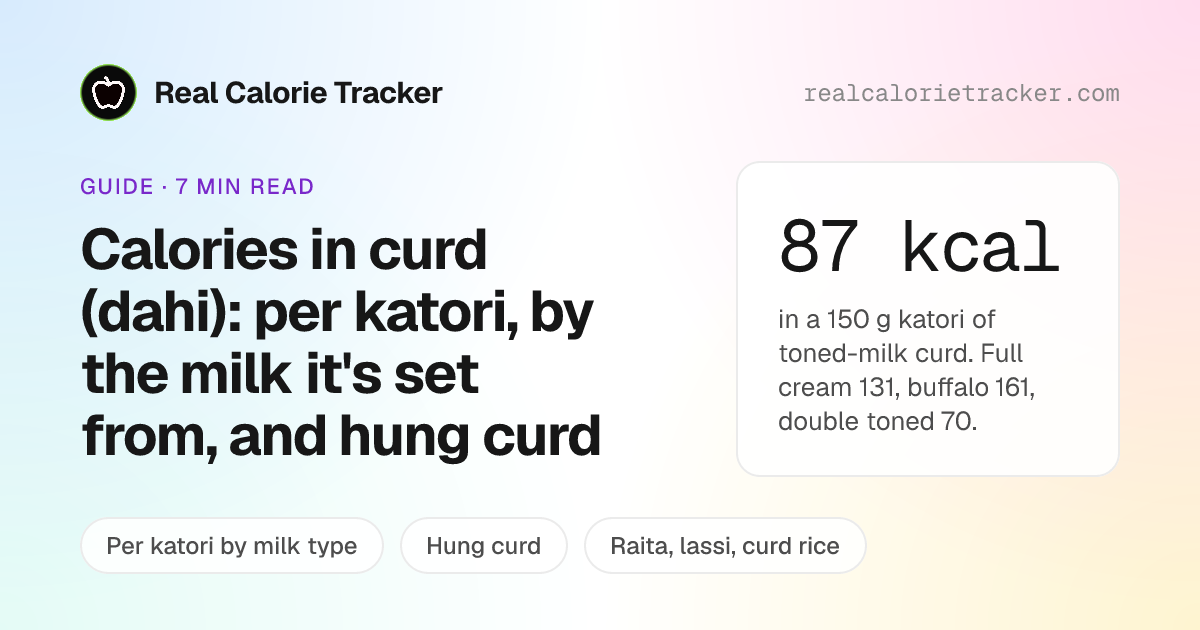
A 150 g katori of plain curd made from toned milk is about 87 calories with 4.8 g of protein. Set the same katori from full cream milk and it’s 131. From buffalo milk, 161. From double toned milk, 70. The protein barely moves across all of them, staying between 4.7 and 5.6 g, so the calorie number is really a fat number, and the fat number is decided by the packet of milk you bought, not by the curd.
Most pages that rank for this query quote one figure, usually 60 to 62 calories per 100 g. That’s the USDA value for American whole-milk yogurt, and it’s what our own curd (dahi) entry uses. It’s a fair middle, but it can be off by 40 percent in either direction for the dahi in your fridge. The table below shows the spread.
Calories in curd by the milk it’s made from
FSSAI rules say dahi must have the same minimum fat and SNF (solids-not-fat) as the milk it’s made from, and if the label doesn’t declare a milk class, the buffalo-milk standard applies. So the milk tells you the curd. The IFCT rows are measured values for raw milk; the rest are my estimates built from the FSSAI minimums for each milk class (6.0, 4.5, 3.0, 1.5 and 0.5 percent fat), assuming typical milk protein and lactose. Fermentation turns some lactose into lactic acid but changes the energy very little.
| Curd made from | Per 100 g | Per 150 g katori | Protein per katori | Fat per katori | Protein per 100 kcal |
|---|---|---|---|---|---|
| Buffalo milk (IFCT) | 107 | 161 | 5.6 g | 9.9 g | 3.5 g |
| Full cream milk, 6% fat (estimate) | 87 | 131 | 5.1 g | 9.0 g | 3.9 g |
| Cow milk, whole (IFCT) | 73 | 110 | 5.0 g | 6.8 g | 4.5 g |
| Standardised milk, 4.5% fat (estimate) | 72 | 108 | 4.8 g | 6.8 g | 4.4 g |
| Curd (dahi), database default | 60 | 90 | 4.7 g | 5.0 g | 5.2 g |
| Toned milk, 3% fat (estimate) | 58 | 87 | 4.8 g | 4.5 g | 5.5 g |
| Double toned milk, 1.5% fat (estimate) | 47 | 70 | 5.1 g | 2.3 g | 7.2 g |
| Skimmed milk, 0.5% fat (estimate) | 37 | 55 | 5.0 g | 0.8 g | 8.9 g |
Most packaged plain dahi in Indian cities is made from toned milk, so if you buy a cup from the dairy brand on your street and the label is missing, 58 to 62 per 100 g is a safe number. Home curd is where people under-count. If your family sets dahi from full cream or buffalo milk, as plenty of North Indian homes do, a katori is 130 to 160 calories, and two katoris a day add 80 to 140 calories more than the 60-per-100 g number would have you log.
The thick, sliceable dahi from a halwai’s matka is often buffalo milk, and the firmness comes from the extra fat and solids. Log it at the buffalo row.
Why the protein stays at about 5 g
Toning milk means adding skim milk or milk powder to whole milk to bring the fat down while keeping the SNF up. Protein lives in the SNF. So when you move from full cream to double toned, you remove almost two-thirds of the calories and keep all of the protein. Per 100 calories, double-toned curd carries 7.2 g of protein against full cream’s 3.9.
That’s the one swap in this guide worth making if you’re counting. A katori of double-toned curd instead of full cream saves 61 calories and costs you nothing in protein. Two katoris a day is about 120 calories, every day, without eating less of anything.
It doesn’t make plain curd a high-protein food. Five grams a katori is roughly what one egg white and a half give you. Curd is a good side, a good cooling thing next to a spicy sabzi, and a decent calcium source. It’s not how a vegetarian hits 60 g of protein a day; the high-protein vegetarian Indian foods list has what actually does.
Hung curd and Greek yogurt
Hanging curd in muslin drains off whey, which is mostly water and lactose with a little protein. USDA’s acid whey (FDC 170885) is 24 calories and 0.8 g protein per 100 g. So hanging concentrates the curd per gram, but it doesn’t add protein per calorie as much as people expect. The home rows below are my estimates for 500 g of curd hung until it halves to 250 g.
| Strained curd | Per 100 g | Protein per 100 g | Protein per 100 kcal |
|---|---|---|---|
| Hung curd from toned milk (estimate) | 92 | 5.6 g | 6.1 g |
| Hung curd from double toned milk (estimate) | 70 | 6.0 g | 8.6 g |
| Hung curd from full cream milk (estimate) | 150 | 6.0 g | 4.0 g |
| Greek yogurt, plain nonfat | 59 | 10 g | 17 g |
| Greek yogurt, whole milk (FDC 2259794) | 94 | 8.8 g | 9.3 g |
| Plain yogurt, whole milk (USDA SR Legacy) | 61 | 3.5 g | 5.7 g |
| Plain yogurt, low fat (USDA) | 63 | 5.3 g | 8.4 g |
This is where a lot of Indian diet advice, including an older version of one of my own plans, goes wrong: home hung curd is not Greek yogurt. Commercial Greek yogurt is strained much harder than a home muslin bag manages, and the nonfat version starts from skim milk, which is why it reaches 10 g of protein at 59 calories. Home hung curd from toned milk is thick and pleasant but sits at 6 g per 100 calories, about where paneer does. If you want the high-protein version at home, hang double-toned curd overnight in the fridge and accept a smaller yield. The low-fat American yogurt row looks good because US yogurts often have extra milk solids added; don’t expect Indian low-fat dahi to match it unless the label says so.
One more USDA quirk: the newer Foundation sample of US whole-milk yogurt (FDC 2259793) came in at 78 calories and 4.5 g fat per 100 g, against 61 in the older record. That lines up with the IFCT whole cow milk row at 73, which is one more reason not to treat 60 as universal.
Curd in what you actually eat
Plain curd is the smallest part of most curd dishes. These are INDB recipes with their stated portions, plus one home build.
| Dish | Portion | Calories | Protein |
|---|---|---|---|
| Cucumber raita | 1 bowl (155 g) | 91 | 6.2 g |
| Bottle gourd raita | 1 bowl (155 g) | 87 | 6.2 g |
| Onion raita | 1 bowl (155 g) | 112 | 7.6 g |
| Mint raita | 1 bowl (105 g) | 82 | 5.9 g |
| Potato raita | 1 bowl (160 g) | 120 | 6.7 g |
| Banana raita | 1 bowl (160 g) | 142 | 6.6 g |
| Peanut raita | 1 bowl (125 g) | 188 | 10.8 g |
| Sweet raita | 1 bowl (190 g) | 188 | 6.1 g |
| Toned curd with 2 tsp sugar (home) | 150 g + 8 g | 118 | 4.8 g |
| Sweetened yogurt | 1 bowl (305 g) | 326 | 16.2 g |
| Curd rice | 1 plate (215 g) | 421 | 12.5 g |
| Salted lassi | 1 tall glass (425 g) | 81 | 6.0 g |
| Sweet lassi | 1 tall glass (440 g) | 158 | 5.7 g |
A vegetable raita is one of the best-value things on an Indian plate: under 100 calories a bowl, filling, and it makes a dry sabzi and two rotis feel like a meal. The thali guide counts it that way. The ones to watch are boondi, peanut and sweet raita, which roughly double the number. There’s no boondi raita row in our data; with a tablespoon of fried boondi (about 10 g) on a cucumber-raita base, I’d log it at about 140.
The INDB curd rice is dense, nearly 200 calories per 100 g, because it’s mostly rice. A home plate of 150 g cooked white rice, a katori of toned curd and a teaspoon of oil in the tadka comes to about 322 calories for 300 g. The rice is two-thirds of that, so if curd rice is your dinner, the rice measure is what to control.
INDB’s lassis are thin recipes, 19 and 36 calories per 100 g. A dhaba sweet lassi made with full-fat dahi and three spoons of sugar is closer to our sweet lassi entry at 225 calories for 250 g, and the Indian drinks guide breaks down chaas, lassi and the rest glass by glass.
How much curd, and which one
The ICMR-NIN My Plate for the Day puts milk and curd together at 300 ml a day for a 2,000-calorie diet, counting about 216 calories and 10 g of protein for it. Two katoris of toned curd (174 calories, 9.6 g protein) fit inside that with room for chai. The same two katoris from buffalo milk are 322.
My rule: buy double toned or toned for daily curd, keep full cream for the occasional shrikhand or a festive raita, and weigh the katori once. A steel katori filled to the rim often holds 180 to 200 g of dahi, not 150, which at toned-milk values is 17 to 29 calories more per helping than the standard number. If you’re building a weight-loss week around Indian food, the Indian diet plan puts 150 g of strained curd into six of seven days and still averages about 1,500.
Log your own katori in the tracker, set a protein target with the macro calculator, and see how curd, paneer and dal compare in the Indian food database. The paneer dishes guide is the next step up if curd’s 5 g a katori isn’t enough.
This guide is general nutrition information. If you have lactose intolerance, kidney disease or another condition that affects dairy intake, follow your doctor’s or dietitian’s advice.
This guide is general information, not medical advice. If you're pregnant, have a medical condition or take medication, talk to a doctor or registered dietitian before changing how you eat.
Written by Sheeraz Ali
Sheeraz builds Real Calorie Tracker and uses it every day. The guides come from his own food tracking and from the IFCT 2017, INDB and USDA data behind the site, with sources linked in the text.
Put it into practice
Log your first meal by grams or by serving. Free, no account needed.
More guides
- What 1,200 calories looks like: two real days, and who should not eat it
Two full 1,200-calorie days, Western (131 g protein) and Indian veg (68 g), item by item. Plus the maths on who 1,200 suits and why most men should skip it.
- What 1,500 calories looks like in a day: three real menus
Three full days at 1,500 calories, Western, Indian vegetarian and Indian non-veg, meal by meal with calories and protein for every item. Plus how to tell whether 1,500 is the right number for you.
- What 1,800 calories looks like: three real days, and who it is a diet for
Three full 1,800-calorie days, home-cooked (137 g protein), a bought-lunch workday and Indian veg, item by item. Plus who 1,800 makes lose weight and who it makes gain.