Calories in dalia: per bowl, sweet vs namkeen, and dalia vs oats for weight loss
40 g of raw dalia is 137 calories with 3.5 g fibre. A namkeen bowl is about 235, a sweet milk bowl 205 to 360. Every version, and how it compares with oats.
By Sheeraz Ali · Published November 15, 2026 · 7 min read
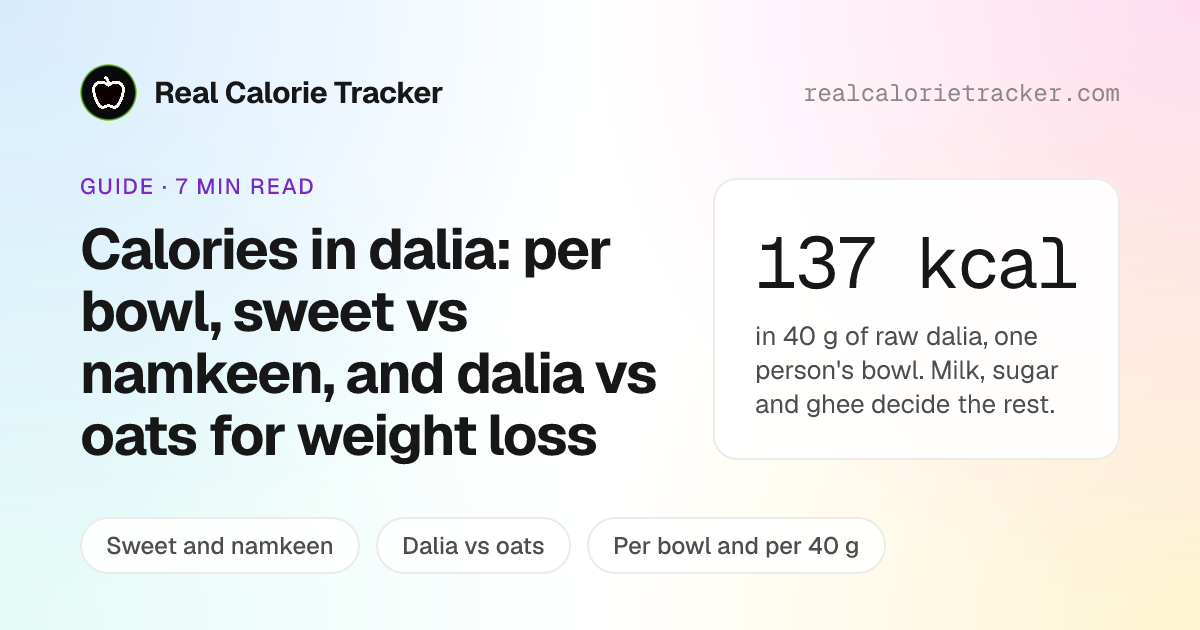
A normal bowl of dalia starts from about 40 g of the dry grain, and that 40 g is 137 calories, 4.3 g of protein and 3.5 g of fibre. Cooked as a namkeen dalia with vegetables and a teaspoon of oil, the bowl comes to about 235 calories. Cooked sweet in whole milk with sugar and a teaspoon of ghee, it is about 360. Made with skimmed milk and no sugar, it drops to about 205.
So the grain is never what makes dalia heavy or light. What you cook it in does. The raw values below come from IFCT 2017, India’s food composition table, and the cooked dishes from INDB recipes in our Indian food database. Where a bowl is built from ingredients instead of a database row, it says so.
Raw dalia against the other breakfast grains
Dalia is whole wheat cracked into pieces, bran and germ included. Here is 40 g of it, raw, next to the grains it usually competes with for the same breakfast slot.
| Grain (raw) | Per 100 g | 40 g raw | Protein in 40 g | Fibre in 40 g |
|---|---|---|---|---|
| Dalia (bulgur wheat) | 342 kcal | 137 kcal | 4.3 g | 3.5 g |
| Rolled oats | 389 kcal | 156 kcal | 6.8 g | 4.2 g |
| Suji / rava | 334 kcal | 134 kcal | 4.6 g | 3.9 g |
| Atta (whole wheat flour) | 320 kcal | 128 kcal | 4.2 g | 4.6 g |
| Ragi | 321 kcal | 128 kcal | 2.9 g | 4.5 g |
| Rice, raw milled | 356 kcal | 142 kcal | 3.2 g | 1.1 g |
Every grain on that list sits within 28 calories per 40 g. Oats come out highest because they carry more fat (about 7 g per 100 g against 1.5 for dalia), and the same fat is part of why oats also win on protein. Dalia is the middle of the pack on everything, which is not a criticism: it is whole wheat, and whole wheat is a decent grain.
One oddity in the table. IFCT lists suji at 9.7 g of fibre per 100 g, close to dalia’s 8.8, while USDA’s coarse semolina is 3.2 g. Suji is the endosperm with most of the bran sifted away, so I trust the lower figure for the packet in an Indian kitchen and treat dalia as the clearly higher-fibre choice of the two.
Dalia per bowl, every common version
| Dish | Portion | Calories | Protein | Source |
|---|---|---|---|---|
| Namkeen dalia, home, 1 tsp oil (40 g dalia, onion, tomato, peas) | 1 bowl | 234 | 7.1 g | Estimate from ingredients |
| Same, cooked with 1 tbsp oil | 1 bowl | 314 | 7.1 g | Estimate from ingredients |
| Sweet dalia, skimmed milk, no sugar (40 g dalia, 200 ml milk) | 1 bowl | 205 | 11.1 g | Estimate from ingredients |
| Sweet dalia, whole milk, 2 tsp sugar, 1 tsp ghee | 1 bowl | 359 | 10.9 g | Estimate from ingredients |
| Cracked wheat porridge (milk dalia) | 1 bowl (405 g) | 332 | 10.5 g | INDB |
| Sweet dalia | 250 g bowl | 353 | 12.8 g | INDB |
| Namkeen daliya | 1 plate (115 g) | 339 | 9.5 g | INDB |
| Sprouted moong daliya | 1 plate (315 g) | 353 | 8.8 g | INDB |
| Dalia khichdi | 250 g bowl | 418 | 19 g | INDB |
| Dalia with moong dal, 2:1, 1 tsp ghee (40 g dalia, 20 g dal) | 1 bowl | 281 | 10.3 g | Estimate from ingredients |
The estimated bowls use IFCT dalia, whole cow’s milk at 73 calories per 100 g, skimmed milk at 34, sugar, ghee, vegetable oil and moong dal, with 50 g each of onion and tomato and 30 g of peas.
INDB’s namkeen daliya is the row I would not use as-is. At 295 calories per 100 g it is barely lighter than dry dalia (342), which means the recipe is cooked down until it is almost dry, and its 115 g “plate” is a small one. If your namkeen dalia is soft and spoonable, the home estimate is closer.
Why the numbers look like this
Water does the bulking, and water is free. Dalia swells as it cooks, so 40 g of dry grain becomes a full bowl. INDB’s milk dalia is only 82 calories per 100 g cooked because most of that bowl is milk and water. That is why dalia feels like a lot of food for the calories, and also why a “bowl” means nothing until you know the raw weight. I weigh the dry dalia, not the cooked bowl, for the same reason given in cooked vs raw food weights: the raw number never changes, the cooked one changes with every pot.
Milk and sugar are the real calorie decision. In the whole-milk sweet bowl, the grain is 137 calories and everything poured on it is 222. Switching to skimmed milk saves 78, dropping two teaspoons of sugar saves 31, and leaving out the ghee saves 45. The ghee is the easiest win, because nobody tastes one teaspoon in a bowl of sweet porridge. A teaspoon of jaggery (about 5 g, 18 calories) costs the same as a teaspoon of sugar (4 g, 15), so swap it for taste if you like, not for weight.
The oil in namkeen dalia is the same story. One teaspoon to one tablespoon of oil is 40 to 120 calories, the entire gap between the two namkeen rows. The tadka for a single bowl needs a teaspoon. The ghee and oil guide has every spoon size.
Protein is dalia’s weak point. At 3.2 g of protein per 100 calories, raw dalia is ordinary wheat, no better than atta. A bowl cooked in water gives you about 7 g. Milk lifts that to 11, and cooking it with moong dal lifts a water-based bowl from 7 to about 10 g for 47 extra calories. INDB’s dalia khichdi reaches 19 g of protein per bowl because the recipe is heavy on dal; it is the best protein of any khichdi in the khichdi guide.
Dalia vs oats for weight loss
Oats get most of the attention, and on paper they win: 40 g of rolled oats has 2.5 g more protein than 40 g of dalia for 19 more calories. If protein per calorie is the only thing you care about, oats.
Dalia wins on the thing that makes a breakfast hold. Boiled bulgur has a measured glycaemic index of 46 to 53 in the studies collected by the University of Sydney’s GI database, much of it from Jenkins et al. 1986 in the American Journal of Clinical Nutrition, which measured boiled bulgur at 46 against 68 for wholemeal bread in the same study. The same database puts traditional rolled-oat porridge mostly at 50 to 63 and instant oats at 76 to 87. The 2021 international GI tables classify 55 and under as low. Cracked wheat stays low because the bran and the intact pieces slow how fast starch reaches the enzymes that digest it; flour has none of that structure left.
GI is not a weight-loss tool on its own, and a low-GI breakfast can still be 400 calories. But between two bowls of equal calories, a coarse dalia keeps its texture and takes longer to eat, while instant oats turn to paste in the bowl. If you already eat steel-cut or rolled oats, keep them; the oatmeal guide has every milk and topping. If you are choosing between dalia and instant oats sachets, choose dalia.
Three dalia breakfasts, with the numbers
| Breakfast | What goes in | Calories | Protein |
|---|---|---|---|
| Cutting | 40 g dalia in water with onion, tomato, peas, 1 tsp oil; 1 katori curd on the side | 324 | 11.8 g |
| Sweet, everyday | 40 g dalia in 200 ml skimmed milk, 1 tsp jaggery, 5 almonds | 258 | 12.4 g |
| Higher protein | 40 g dalia and 20 g moong dal, vegetables, 1 tsp ghee; 1 katori curd | 371 | 15 g |
The curd is a 150 g katori at 90 calories and 4.7 g of protein, and five almonds are about 6 g, 35 calories and 1.3 g of protein. All three stay under 375 calories with 12 g of protein or more, which is the bar I use for a breakfast; the low-calorie Indian breakfast ranking puts poha, upma and cheela against the same bar.
Logging dalia
Log the dry weight of the dalia, then add the milk, sugar, ghee or oil as separate lines. That is four entries and about thirty seconds, and it is accurate whatever your pot looks like. If you make a big pot for the family, weigh the dry dalia going in and the cooked pot coming out once, and divide.
For a daily target to fit the bowl into, the calorie deficit calculator gives you a number in a minute, and the tracker has IFCT dalia and all the INDB dalia dishes by bowl and by gram. For more grains and dals that do well on fibre, see high-fibre Indian foods.
This guide is general nutrition information, not medical advice. If you have diabetes, ask your doctor or dietitian how a dalia breakfast fits your plan; GI values come from small study groups and your own response can differ.
This guide is general information, not medical advice. If you're pregnant, have a medical condition or take medication, talk to a doctor or registered dietitian before changing how you eat.
Written by Sheeraz Ali
Sheeraz builds Real Calorie Tracker and uses it every day. The guides come from his own food tracking and from the IFCT 2017, INDB and USDA data behind the site, with sources linked in the text.
Put it into practice
Log your first meal by grams or by serving. Free, no account needed.
More guides
- What 1,200 calories looks like: two real days, and who should not eat it
Two full 1,200-calorie days, Western (131 g protein) and Indian veg (68 g), item by item. Plus the maths on who 1,200 suits and why most men should skip it.
- What 1,500 calories looks like in a day: three real menus
Three full days at 1,500 calories, Western, Indian vegetarian and Indian non-veg, meal by meal with calories and protein for every item. Plus how to tell whether 1,500 is the right number for you.
- What 1,800 calories looks like: three real days, and who it is a diet for
Three full 1,800-calorie days, home-cooked (137 g protein), a bought-lunch workday and Indian veg, item by item. Plus who 1,800 makes lose weight and who it makes gain.