Calories in oatmeal: per ½ cup, with each milk, every topping and overnight oats
½ cup of dry oats is 156 calories with water, 302 with whole milk. Toppings decide the rest: banana, peanut butter and honey make it 513. Each topping counted.
By Sheeraz Ali · Published November 1, 2026 · 8 min read
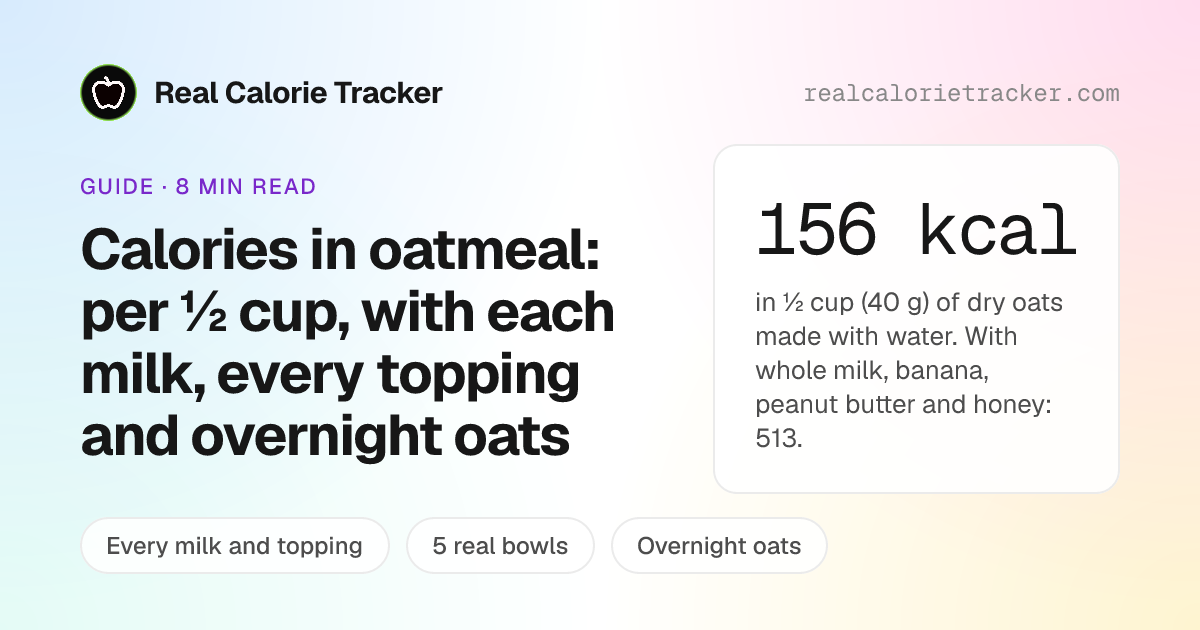
Half a cup of dry rolled oats (40 g) is 156 calories made with water. Make it with a cup of whole milk and it is 302. The oats are the cheap part: a bowl with half a banana, a tablespoon of peanut butter and a tablespoon of honey stirred in is 513 calories, and a generous “healthy” bowl with walnuts, dates and maple syrup passes 800 without looking unusual.
So the answer to “how many calories are in oatmeal” depends on three choices: how much dry oats, which liquid, and what goes on top. Each one is counted below, using USDA-based values from the food database. Every item links to its own page.
The base: oats plus liquid
| Bowl base | Calories | Protein | Fibre |
|---|---|---|---|
| Rolled oats, ½ cup dry (40 g), with water | 156 | 6.8 g | 4.2 g |
| + 1 cup unsweetened almond milk instead | 192 | 8.2 g | 4.9 g |
| + 1 cup skim milk instead | 238 | 15.0 g | 4.2 g |
| + 1 cup soy milk instead | 286 | 14.7 g | 5.6 g |
| + 1 cup whole milk instead | 302 | 14.5 g | 4.2 g |
| Rolled oats, 1 cup dry (80 g), with water | 311 | 13.5 g | 8.5 g |
| Steel-cut oats, 40 g dry, with water | 152 | 5.0 g | n/a |
Oat packets usually round the 40 g serving to 150 calories; our USDA entry says 156. Same oats.
Whole milk adds almost exactly as many calories as the oats themselves. Skim milk adds about half that and the same 8 g of protein, which makes it the best liquid here if you want the bowl to do some protein work. Almond milk is the lowest-calorie option and adds next to nothing else, protein included. Half water and half skim is a good middle: creamy enough, and 197 calories for the base.
Steel-cut, rolled and quick oats are the same grain cut differently. Per dry gram the calories are within a few percent of each other (our two USDA entries differ by 10 per 100 g). Pick the one whose texture and cooking time you like.
Toppings, by the amount people actually use
| Topping | Amount | Calories | Protein |
|---|---|---|---|
| Cocoa powder, unsweetened | 1 tbsp (5 g) | 11 | 1.0 g |
| Sugar | 1 tsp (4 g) | 15 | 0 g |
| Blueberries | ½ cup (74 g) | 42 | 0.5 g |
| Strawberries | 1 cup (152 g) | 49 | 1.1 g |
| Maple syrup | 1 tbsp (20 g) | 52 | 0 g |
| Banana | ½ medium (59 g) | 53 | 0.6 g |
| Flaxseed | 1 tbsp (10 g) | 53 | 1.8 g |
| Chia seeds | 1 tbsp (12 g) | 58 | 2.0 g |
| Greek yogurt, plain | 100 g | 59 | 10.0 g |
| Raisins | 2 tbsp (20 g) | 60 | 0.6 g |
| Honey | 1 tbsp (21 g) | 64 | 0.1 g |
| Walnuts | ½ oz (14 g) | 92 | 2.1 g |
| Peanut butter | 1 level tbsp (16 g) | 94 | 4.0 g |
| Almond butter | 1 level tbsp (16 g) | 96 | 3.3 g |
| Medjool dates | 2 (48 g) | 133 | 0.9 g |
| Almonds | 1 oz (28 g) | 162 | 5.9 g |
| Hemp seeds | 3 tbsp (30 g) | 166 | 9.5 g |
| Granola | ½ cup (61 g) | 298 | 8.4 g |
The split is clean. Fruit, cocoa and a teaspoon of sugar are under 55 calories a serving. Nuts, nut butters, dates and granola are 90 to 300. A half cup of granola on oatmeal is more calories than the oatmeal, which is a strange thing to do to a bowl of oats.
Why oatmeal calories run away
Fat-dense toppings are measured by eye. Nuts and nut butters are about 580 to 650 calories per 100 g. A level tablespoon of peanut butter is 16 g and 94 calories; a spoon dug out of the jar and dropped on hot oats is often a heaped one. Weigh your normal spoonful once on a kitchen scale. Whatever it turns out to be, that is the number to log from then on.
Sweeteners stack invisibly. Honey and maple syrup are 52 to 64 calories per tablespoon and dissolve into the bowl, so a second drizzle leaves no trace. Fresh fruit sweetens for less: half a banana mashed in while the oats cook is 53 calories and makes the honey unnecessary. Riper bananas are sweeter for the same calories (calories in a banana explains the starch-to-sugar shift).
Cooked oatmeal has no fixed weight. 40 g of oats with 250 ml of water comes out at about 290 g of porridge. Use 160 ml and the same oats weigh about 200 g. That is why a calorie count per 100 g of cooked oatmeal is close to useless unless you made it the same way. Weigh the oats dry, then log the milk and toppings separately. Cooked vs raw food weights explains the same problem for rice and pasta.
Portion creep in the oats themselves. Half a cup dry looks small in a big bowl, so many people pour closer to a cup. That adds 155 calories before anything goes on top. Rolled oats are about 80 g per cup, so a scale settles it in five seconds.
Five bowls, counted
| Bowl | What’s in it | Calories | Protein | Fibre |
|---|---|---|---|---|
| Plain and light | 40 g oats, water, ½ cup blueberries, cinnamon | 198 | 7 g | 6 g |
| Overnight oats | 40 g oats, ½ cup skim milk, 100 g Greek yogurt, 1 tbsp chia, ½ cup blueberries | 356 | 23 g | 10 g |
| Protein oats | 40 g oats, 1 cup skim milk, 170 g Greek yogurt stirred in after cooking, ½ banana | 391 | 33 g | 6 g |
| Café-style | 40 g oats, 1 cup whole milk, ½ banana, 1 tbsp peanut butter, 1 tbsp honey | 513 | 19 g | 7 g |
| The big “healthy” bowl | 80 g oats, 1 cup whole milk, 1 oz walnuts, 2 dates, 1 tbsp maple syrup | 825 | 26 g | 14 g |
Cinnamon is a few calories a teaspoon and not worth logging.
The overnight oats bowl is the one I would build a cutting diet around: 356 calories, 23 g of protein, 10 g of fibre, and it is made the night before. The protein oats bowl is the best for protein per calorie; Greek yogurt stirred into warm oats turns them creamy without milk fat. The café bowl is a reasonable breakfast if it fits your day. The big bowl is lunch-sized, and that is fine as long as it is logged as lunch.
Oats alone give you 6.8 g of protein, which is not enough to anchor a meal if you are aiming for 1.6 g of protein per kg of body weight a day while losing weight. Skim milk and Greek yogurt are the easy fixes (40 g of oats in skim milk with 150 g of Greek yogurt stirred in is 31 g of protein for 352 calories; high-protein breakfasts under 400 calories has it alongside eight others), and Greek yogurt sits near the top of the highest-protein foods per calorie. Hemp seeds add 9.5 g per 3 tbsp, but at 166 calories they are a fat food with a protein bonus.
Is oatmeal actually good for weight loss?
It earns its reputation on fullness, not on low calories. In a 2016 randomised crossover trial with 48 adults, instant oatmeal produced more fullness and less hunger than an oat-based cold cereal with the same calories, and people ate less at lunch afterwards. The study was funded by PepsiCo, which owns Quaker, so weigh it accordingly, but the proposed mechanism is plausible and specific: oatmeal is a viscous porridge rich in beta-glucan, a soluble fibre that thickens in water and slows digestion.
The same beta-glucan carries the one health claim regulators have signed off on. The US FDA allows oat products to state that 3 g a day of beta-glucan soluble fibre from whole oats or barley, as part of a diet low in saturated fat and cholesterol, may reduce the risk of heart disease. The rule was built on roughly 60 g of oatmeal a day supplying that 3 g, so a 40 g bowl gives you about two thirds of it.
Fibre is the other quiet win. A 40 g bowl has 4.2 g; add chia and berries and it is 10 g, a third of the UK’s 30 g daily target before 9 a.m. The fibre guide has the rest of the list. If you eat Indian breakfasts, cracked wheat is the other porridge worth knowing: 40 g of dry dalia is 137 calories with a lower measured GI than instant oats, as calories in dalia shows.
What oatmeal will not do is offset what you put on it. A 156-calorie bowl of oats is a filling breakfast. An 825-calorie bowl of oats is a filling lunch eaten at breakfast.
Set your daily target with the calorie deficit calculator, check your protein split in the macro calculator, and log oats in the tracker by dry weight with each topping on its own line. After a week you will know exactly which spoonful was doing the damage.
This guide is general information, not medical advice. If you're pregnant, have a medical condition or take medication, talk to a doctor or registered dietitian before changing how you eat.
Written by Sheeraz Ali
Sheeraz builds Real Calorie Tracker and uses it every day. The guides come from his own food tracking and from the IFCT 2017, INDB and USDA data behind the site, with sources linked in the text.
Put it into practice
Log your first meal by grams or by serving. Free, no account needed.
More guides
- What 1,200 calories looks like: two real days, and who should not eat it
Two full 1,200-calorie days, Western (131 g protein) and Indian veg (68 g), item by item. Plus the maths on who 1,200 suits and why most men should skip it.
- What 1,500 calories looks like in a day: three real menus
Three full days at 1,500 calories, Western, Indian vegetarian and Indian non-veg, meal by meal with calories and protein for every item. Plus how to tell whether 1,500 is the right number for you.
- What 1,800 calories looks like: three real days, and who it is a diet for
Three full 1,800-calorie days, home-cooked (137 g protein), a bought-lunch workday and Indian veg, item by item. Plus who 1,800 makes lose weight and who it makes gain.