Intermittent fasting and calories: does the eating window matter if you eat the same amount?
In trials that matched calories, eating in an 8-hour window lost 1.8 kg more over a year, not a significant gap. What the window does, and what breaks a fast.
By Sheeraz Ali · Published November 13, 2026 · 8 min read
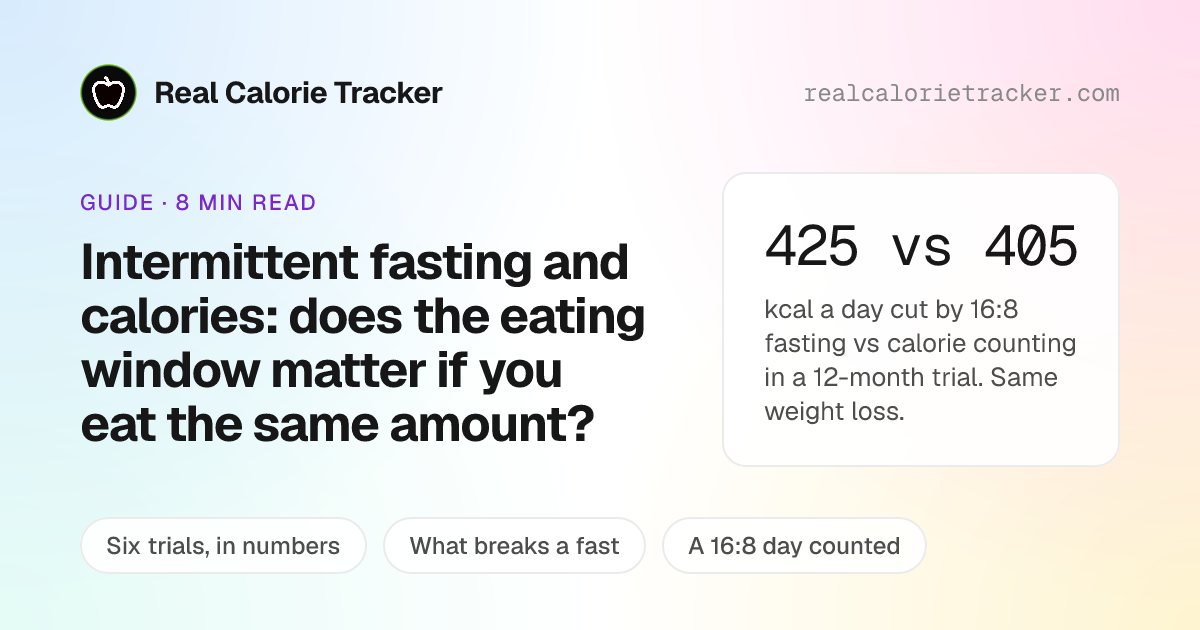
Calories still count when you fast. In the trials that held calories equal, eating inside an 8-hour window did not produce meaningfully more weight loss than eating the same amount across the day. Where intermittent fasting works, it works because people eat less: in a 12-month trial at the University of Illinois, the 16:8 group cut 425 calories a day without counting anything, the calorie-counting group cut 405, and both lost about 5 percent of their weight (Lin et al., Annals of Internal Medicine, 2023).
That makes fasting a tool for eating less, and a decent one for some people. It does not make food eaten in the window free. The rest of this guide is the trial numbers, what counts as breaking a fast in calories, and a 16:8 day with every item weighed from our food database.
What the trials found
Six randomised trials, the ones most often cited, with the numbers from their abstracts.
| Trial | Who | Comparison | Length | Result |
|---|---|---|---|---|
| Lowe et al., JAMA Intern Med 2020 (TREAT) | 116 adults, BMI 27 to 43 | Eat freely 12 p.m. to 8 p.m. vs three meals a day | 12 weeks | −0.94 vs −0.68 kg; difference 0.26 kg, not significant. More lean mass lost in the fasting group |
| Liu et al., NEJM 2022 | 139 adults with obesity | Same calorie target (1,200 to 1,800), eaten 8 a.m. to 4 p.m. or any time | 12 months | −8.0 vs −6.3 kg; difference 1.8 kg, P = 0.11 (not significant) |
| Jamshed et al., JAMA Intern Med 2022 | 90 adults with obesity | Same calorie advice, eaten 7 a.m. to 3 p.m. or over 12+ hours | 14 weeks | 2.3 kg more lost with the early window, which the authors equate to eating 214 fewer calories a day |
| Lin et al., Ann Intern Med 2023 | 90 adults with obesity | 12 p.m. to 8 p.m. without counting vs a 25% calorie cut vs control | 12 months | −4.6 vs −5.4 kg against control; difference not significant |
| Trepanowski et al., JAMA Intern Med 2017 | 100 adults with obesity | Alternate-day fasting vs a daily 25% cut | 12 months | −6.0% vs −5.3% of body weight; 38% vs 29% dropped out |
| Catenacci et al., Ann Intern Med 2025 | 165 adults, BMI 27 to 46 | 4:3 fasting (80% cut on 3 days) vs a daily 34% cut, both with intensive support | 12 months | 2.89 kg more lost with 4:3 |
Read across the table and two things are clear. When calories are matched, as in Liu’s trial, the window adds a kilogram or two over a year at most, and the trials are too small to say whether even that is real. And when nobody is told to count, as in TREAT, a 16:8 window on its own barely moves the scale (under a kilogram in 12 weeks), because people eat their usual day in eight hours.
The two trials with an edge for fasting are worth reading honestly. Jamshed’s early window (7 a.m. to 3 p.m.) beat a 12-hour day by 2.3 kg in 14 weeks, and the authors expressed it as the same as eating 214 fewer calories a day. Catenacci’s 4:3 pattern beat daily restriction by 2.9 kg, inside a programme with group support and 300 minutes of weekly exercise advice for both arms. Neither shows that calories stop counting. Both suggest that some ways of structuring a deficit are easier to stick to than others.
Why a window helps some people eat less
The mechanism is boring and real. Skipping breakfast removes one eating occasion, and for many people breakfast is a meal they would not miss: 40 g of oats cooked in a glass of whole milk with a banana is about 400 calories (calories in oatmeal has the variations). Closing the kitchen at 8 p.m. removes the evening snacking that a lot of overeating happens in. Neither changes your metabolism. Both shrink the day.
It fails in the opposite way. If the first meal at noon is a 1,000-calorie lunch because you are starving, and the window closes with a large dinner at 7:59, you have eaten your usual 2,400 calories in eight hours. TREAT found no difference in estimated intake between its two groups, which is why its weight results were the same.
The lean-mass result in TREAT is the warning to take seriously. With fewer meals, protein has fewer chances to arrive, and two meals of 20 g is a low-protein day. Build each meal in the window around 40 g or more. The macros for weight loss guide sets the daily target at about 1.8 g per kg, which two meals and a snack can carry if each one has a real protein portion.
What breaks a fast, in calories
There is no agreed threshold, and if your goal is weight loss the question that matters is how many calories the drink adds to your day. Our numbers per typical serving:
| Drink | Serving | Calories |
|---|---|---|
| Black coffee | 1 cup (240 ml) | 2 |
| Green tea, unsweetened | 1 cup (237 ml) | 2 |
| Diet cola | 1 can (355 ml) | 0 |
| Water with lemon | 10 g of juice | 3 |
| Coffee with a splash of whole milk | 15 ml | 9 |
| Coffee with unsweetened almond milk | 30 ml | 5 |
| Coffee with heavy cream | 1 tbsp (15 ml) | 51 |
| Chicken stock or broth | 1 cup (240 ml) | 72 |
| Chai, 100 ml milk and 1 tsp sugar | 1 cup | 76 |
| “Butter coffee” with 1 tbsp butter | 1 cup | 102 |
| Buttermilk | 1 glass (240 ml) | 103 |
| Orange juice | 1 glass (248 ml) | 112 |
| Cola | 1 can (355 ml) | 149 |
| Latte, whole milk | 360 ml | 202 |
Black coffee, plain tea, water and diet drinks are a fast by any definition. A splash of milk under 10 calories makes no practical difference to weight loss. Chai with sugar, butter coffee and a latte are small meals, and should be logged as food. Two cups of sweet chai in the “fasting” morning is 153 calories, which is how a 16:8 plan quietly becomes a 24-hour eating day with a gap in it. The Indian drinks guide has every chai and lassi variation.
A 16:8 day, counted
A noon-to-8 day at about 1,650 calories, with each meal built around a protein anchor. Calculated from portion weights in the database.
| Time | What | Calories | Protein |
|---|---|---|---|
| 12:00 | Latte, whole milk (360 ml) | 202 | 11 g |
| 12:30 | Chicken breast stir-fry (150 g) with ¾ cup rice, peppers, broccoli, mushrooms, 2 tsp olive oil | 578 | 57 g |
| 16:00 | 245 g Greek yogurt, 1 banana, 15 g almonds | 336 | 29 g |
| 19:30 | Salmon fillet (154 g), ¾ cup rice, 150 g broccoli | 527 | 41 g |
| Total | 1,643 | 138 g |
Black coffee and water before noon. The latte opens the window; it is in the count because it is 202 calories. Without it the day is 1,441, which is a reasonable target for many women and a steep one for most men. The high-protein dinner guide has a dozen alternatives to the 7:30 meal at the same size.
Should you use it
Use a window if breakfast is a meal you eat out of habit rather than hunger, or if your overeating happens after dinner. Both are common, and both are fixed by the clock without any counting. If you can, make the window earlier rather than later: Jamshed’s 7-to-3 result is the best evidence that timing adds something, and an earlier dinner is easier than an earlier everything.
Skip it if long gaps make you overeat when you do eat, if you train in the morning and cannot get protein in for hours afterwards, or if you have a history of disordered eating. In three of the five trials above that compared fasting with ordinary daily restriction, daily restriction did as well, and the other two found gaps of 2 to 3 kg. What decides the result is the deficit, so start from your number in the calorie deficit calculator or the TDEE calculator, then pick the pattern you can keep. If you are fasting and the scale has stopped, the usual reasons are in calorie deficit not working, and the tracker will show whether your eight hours add up to more than you think.
This guide is general information, not medical advice. If you have diabetes, take medication that affects blood sugar, are pregnant or breastfeeding, are under 18, or have a history of disordered eating, talk to a doctor before fasting.
This guide is general information, not medical advice. If you're pregnant, have a medical condition or take medication, talk to a doctor or registered dietitian before changing how you eat.
Written by Sheeraz Ali
Sheeraz builds Real Calorie Tracker and uses it every day. The guides come from his own food tracking and from the IFCT 2017, INDB and USDA data behind the site, with sources linked in the text.
Put it into practice
Log your first meal by grams or by serving. Free, no account needed.
More guides
- What 1,200 calories looks like: two real days, and who should not eat it
Two full 1,200-calorie days, Western (131 g protein) and Indian veg (68 g), item by item. Plus the maths on who 1,200 suits and why most men should skip it.
- What 1,500 calories looks like in a day: three real menus
Three full days at 1,500 calories, Western, Indian vegetarian and Indian non-veg, meal by meal with calories and protein for every item. Plus how to tell whether 1,500 is the right number for you.
- What 1,800 calories looks like: three real days, and who it is a diet for
Three full 1,800-calorie days, home-cooked (137 g protein), a bought-lunch workday and Indian veg, item by item. Plus who 1,800 makes lose weight and who it makes gain.